
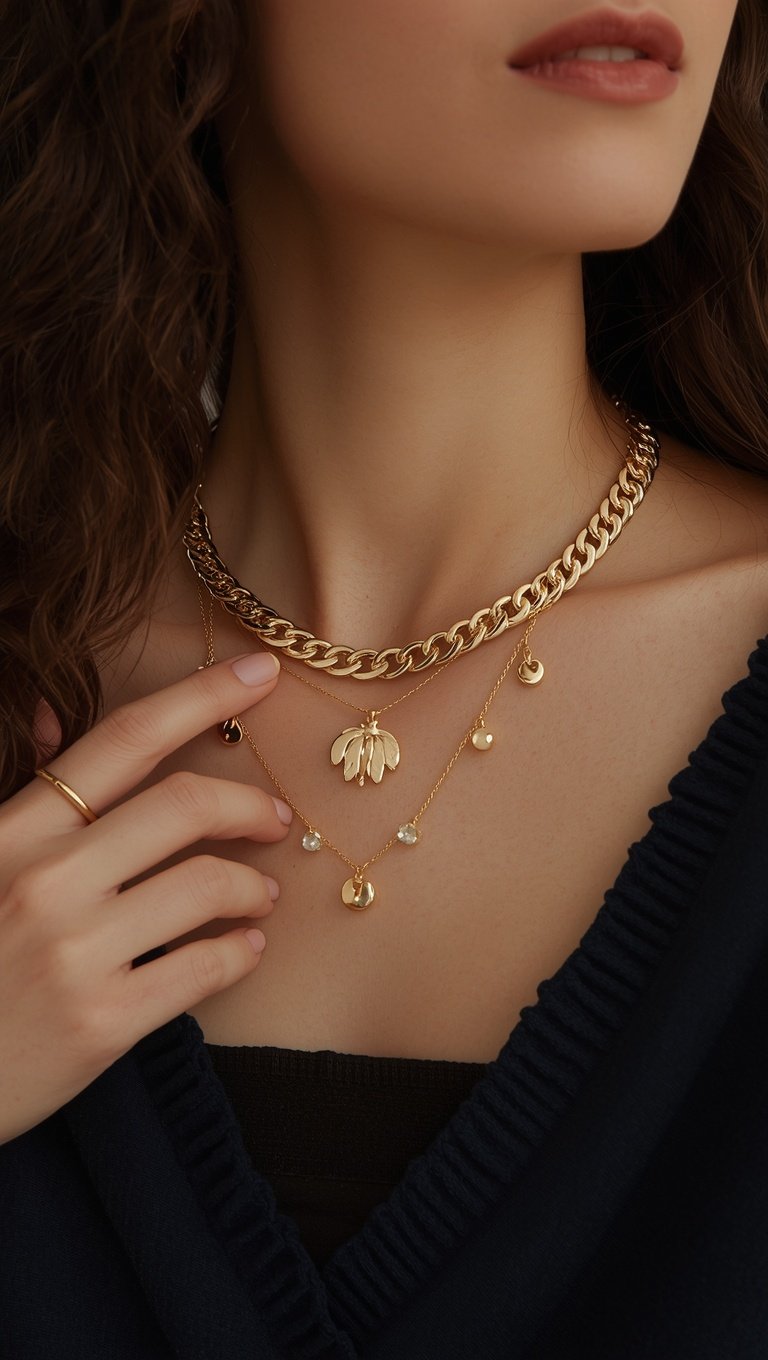
I used to open my jewelry box, grab every gold piece I owned, and pile them on all at once.
And every single time, I’d catch my reflection and think, wait, this looks messy, not chic.
There’s this fine line between “effortlessly layered” and “did she get dressed in the dark,” and for years I lived on the wrong side of it.
It took me embarrassingly long to figure out the difference wasn’t about how much gold I wore.
It was about how I wore it.
So if you’ve ever tangled three necklaces into one sad knot, or felt like your stack of rings was fighting itself, I get it, I’ve been there, and I want to walk you through exactly what changed for me.
Start With One Hero Piece

Every good stack needs a piece that leads the whole look.
For me, it’s usually a slightly chunky curb chain that sits close to my collarbone.
I pick that piece first, before anything else touches my neck or wrist.
Think of it as the sentence, and everything else you add is punctuation.
If you skip this step and just grab whatever’s closest, that’s usually when things start to feel busy.
I learned this the hard way during a trip when I threw on four necklaces with zero plan.
By noon they were a tangled little ball at the base of my throat, and honestly, kind of embarrassing.
Now I always ask myself, what’s the one piece I’d keep if I could only wear one thing today.
That answer becomes my anchor.
Everything else gets layered around it, never competing with it.
My personal tip: your hero piece should be the boldest or most substantial one you own.
A thicker chain, a piece with texture, or something with a little personality works so well here.
Delicate pieces are wonderful, but they make weak anchors because they kind of disappear into the mix.
So start bold, then get delicate from there.
It’s such a small shift, but it changes everything about how put-together the whole look feels.
Vary Your Chain Lengths on Purpose

This one sounds obvious, but I promise it’s the number one thing people skip.
If every necklace sits at the exact same length, they just blend into one clump.
Your eye can’t tell where one piece ends and the next begins.
So I always aim for at least an inch or two of difference between each layer.
My go-to formula is a choker-length piece close to the neck, a mid-length piece that hits around the collarbone, and a longer pendant that drops toward the chest.
That spacing gives each necklace room to actually be seen.
Honestly, this was the single fix that changed my layering game the most.
Before I understood spacing, I’d just clip on three necklaces of similar length and wonder why it looked cluttered.
Now I lay them flat on my dresser first and eyeball the lengths before I even put them on.
It takes ten extra seconds and it’s worth it every time.
A little variation goes such a long way.
And if you only own necklaces that are close in length, don’t stress, you can still make it work by choosing one to wear slightly looser or tucked half into your shirt.
Small tricks like that create the illusion of spacing even when your actual pieces don’t give you much room to play with.
Mix Textures, Not Just Different Metals

People think layering gold is just about stacking chains, but texture is honestly the secret ingredient.
If every piece has the same smooth, simple chain, it can start to look a little flat, you know.
So I like mixing a delicate cable chain with something that has beading, twisting, or a bit of hammered texture.
It gives your eye somewhere new to land on each layer.
One of my favorite combos is a smooth snake chain paired with a rope-twist chain and then a dainty bead necklace.
Three totally different textures, same warm gold tone, and somehow it just clicks.
When I first started paying attention to texture instead of just length, my whole jewelry drawer felt more useful.
Pieces I used to think “didn’t go together” suddenly worked because the contrast was actually the point.
If I had to give one quick hack, it’s this: always include at least one textured piece in your stack.
It keeps things from feeling too matchy or too plain.
And if you’re someone who loves a minimal look, even a subtle texture, like a slightly twisted chain, adds enough interest without feeling loud.
Little details like this are what make an outfit feel curated instead of thrown together.
It’s such a simple swap, but it makes such a noticeable difference in photos too.
The Rule of Odd Numbers

This is one of those little style tricks that just works, and I use it constantly.
Odd numbers of pieces, like three necklaces or five bangles, tend to look more intentional than even numbers.
I genuinely can’t explain the science behind it, but my eye always agrees with it.
Two necklaces can feel a little unfinished, and four can tip into overwhelming territory fast.
Three feels balanced, curated, like you actually thought about it instead of just grabbing a handful.
I use this rule for bracelets too, especially when I’m stacking on one wrist.
A trio of thin bangles with slightly different widths always looks more polished than four identical ones.
It’s become sort of a mental checklist for me now before I walk out the door.
I glance down, count what I’m wearing, and if it’s an even number, I usually add or remove one piece.
It sounds a little obsessive typing it out, but it takes two seconds and it works every time.
If you’re someone who overthinks accessorizing like I used to, this rule genuinely simplifies the decision.
You don’t need ten options, you need three good ones that work together.
Keep this one in your back pocket, it’s such a easy trick for quick mornings when you don’t have time to fuss.
Let Only One Piece Be the Statement

A stack with three loud pieces just cancels itself out, nobody wins.
So I pick one piece to be the star, usually my chunkiest chain or a pendant with real presence.
Everything else gets to be quiet, simple, supportive.
It’s kind of like getting dressed for a party, someone has to be the main character.
When I want my chunky chain to shine, I pair it with two thin, plain chains that barely have any detail at all.
They’re there to add layers and depth, not to steal focus.
I made this mistake so many times early on, wearing a bold chain paired with an equally bold pendant necklace and a chunky charm bracelet.
It was all just noise, nothing stood out because everything was shouting at once.
Now before I leave the house, I ask myself which piece I actually want people to notice.
Once I know the answer, styling the rest becomes so much easier.
My favorite version of this rule is pairing one signature vintage-inspired pendant with two barely-there chains underneath.
The pendant gets all the attention, and the thin chains just add subtle shimmer and dimension.
It photographs beautifully too, especially in natural light where the thin chains catch a little sparkle without competing with the main piece.
Don’t Forget Your Bracelets and Wrist Stack

Necklaces get all the attention in layering talk, but your wrists deserve the same care.
I used to just throw on random bracelets with zero thought, and it always looked scattered.
Now I treat my wrist stack with the same rules as my neck, one anchor piece, then supporting pieces around it.
My anchor is usually a slightly wider cuff or a chain bracelet with some weight to it.
Then I add one or two thinner bangles that move and catch light when I gesture.
There’s something so satisfying about the little clink they make when you’re talking with your hands.
If I had a favorite combo, it would be a solid gold cuff paired with a delicate chain bracelet and one thin textured bangle.
Three pieces, three different weights, and somehow it always feels finished.
One little hack I use constantly, if your bracelets keep sliding around and tangling, try wearing them on opposite wrists instead of stacking them all on one arm.
It instantly makes the whole look feel more spread out and intentional.
And honestly, it’s more comfortable too, especially if you’re typing or writing all day like I am.
Give your wrists the same love you give your neckline, they genuinely finish an outfit in such a quiet, Don’t Forget Your Bracelets and Wrist Stack
Rings Deserve a Little Strategy Too
I went through a phase where I wore rings on every single finger, and it just felt heavy and cluttered.

Now I follow a much simpler approach, one statement ring and a couple of thin bands nearby.
I usually put my boldest ring on my middle finger and let thinner bands sit on my index or pinky.
That contrast between bold and delicate does so much visual work without trying too hard.
Stacking two or three thin bands on the same finger is another favorite trick of mine.
They sit close together and almost look like one textured ring from a distance, which feels so intentional.
My honest tip here, don’t put a chunky ring on every finger, your hands need breathing room just like your neckline does.
I learned this after seeing photos of myself where my hands looked almost armored, and it just wasn’t the vibe I wanted.
Now I leave at least one finger completely bare on each hand.
It sounds small, but it makes the whole hand feel more elegant instead of overloaded.
If you’re just starting to build a ring collection, invest in one good statement piece first, then fill in with thin gold bands over time.
That’s exactly how I built mine, piece by piece, and it never once felt cluttered along the way.
My Personal Everyday Layering Formula

People ask me all the time what I actually wear on a normal day, so here’s my honest answer.
I wear a short chain close to my neck, a slightly longer chain with a small charm, and one delicate pendant that hangs the lowest.
On my wrist, I do one chain bracelet and one thin bangle, nothing fussy.
And for rings, just my statement ring and two thin stacked bands on the opposite hand.
That’s it, that’s genuinely my whole formula, and I rarely change it up unless I’m dressing for something special.
The beauty of having a formula is that I never stand in front of my jewelry box overthinking it anymore.
I used to spend way too long deciding, and mornings felt so much more stressful because of it.
Now I just reach for the same core pieces and I know it’ll work.
If I’m feeling a little fancier, I’ll swap the small charm necklace for something with more texture or add one extra thin bangle.
But the bones of the formula stay exactly the same.
Having a go-to system like this takes so much pressure off getting dressed.
I genuinely think every person should build their own version of this, it saves so much mental energy in the morning.
Common Mistakes That Make a Stack Look Cluttered

The biggest mistake I see, and used to make myself, is wearing too many similar pieces at once.
If every necklace is the same width and the same length, your eye just can’t separate them.
Another one is mixing metals without any real plan, gold and silver can absolutely work together, but only with intention behind it.
Random mixing usually just reads as messy instead of eclectic.
Overcrowding is probably the biggest culprit though, more isn’t automatically better, even though it feels that way when you’re excited about your jewelry collection.
I also used to make the mistake of matching my earrings to every single necklace I wore, which honestly just felt so matchy and dated.
Now I let my earrings do their own thing, usually something small and simple if my necklace stack is already busy.
Tangling is another sneaky issue, if your chains keep knotting together, it’s usually a length problem, not a bad luck problem.
Space them out more and the tangling tends to solve itself.
My last little tip here, if you’re not sure whether your stack is too much, take it off one piece at a time and pause after each removal.
Nine times out of ten, you’ll land on the right amount before you’ve removed everything.
That trick alone has saved so many of my outfits.
Mixing Vintage Pieces With New Ones

Some of my favorite gold pieces are things I inherited or found at little vintage shops over the years.
And I used to keep them totally separate from my newer, more modern pieces, like they belonged in two different jewelry boxes.
But honestly, mixing them together is where the real magic happens.
A worn, slightly imperfect vintage chain sitting next to a crisp, clean modern piece tells such a nice little story.
It feels layered in more ways than one, if that makes sense.
My grandmother’s thin gold band is something I wear stacked with two brand new rings almost every day now.
It doesn’t match perfectly, and that’s exactly why I love it.
If you’ve got pieces sitting in a drawer that feel too old-fashioned to wear alone, try mixing them into a stack instead of wearing them solo.
They soften next to newer pieces and suddenly feel current again.
This is honestly one of my favorite ways to make a jewelry collection feel more personal and less like it came straight off a store shelf.
It’s not about everything matching perfectly.
It’s about everything feeling like it belongs to you, specifically, and nobody else’s collection would look quite the same.
Dressing Your Layers for Day Versus Night

My daytime stack and my nighttime stack are honestly pretty different, and I think that’s part of what keeps things feeling fresh.
During the day, I keep things simple, thinner chains, smaller charms, nothing too flashy for running errands or sitting at my desk.
At night, I let myself go a little bolder, adding one more chain or swapping in a chunkier piece I’d never wear to the grocery store.
It’s such a small shift but it changes the whole energy of the look.
For evening, I also love adding a bit more shimmer with texture, hammered pieces or ones with tiny gemstone accents catch candlelight so beautifully.
During the day under harsher light, I actually prefer smoother, simpler pieces, they photograph and wear better in sunlight.
My honest tip, keep one or two “night pieces” set aside that you don’t wear casually.
That way when you do put them on, they still feel special instead of overly familiar.
I have one chunky chain I genuinely only wear for dinners out, and every time I put it on, it still gives me that little spark of excitement.
Saving certain pieces for certain moments keeps your whole collection feeling exciting instead of routine.
It’s a small mindset shift, but it’s made getting dressed for nights out so much more fun for me.
Building Your Collection Slowly and Intentionally

I didn’t buy all my layering pieces at once, and honestly, I don’t think you should either.
My collection grew slowly, one piece at a time, usually when I found something that felt like it was actually missing from my rotation.
That slower approach meant every piece I added had a real purpose, instead of just cluttering a drawer.
When you’re just starting out, I’d focus on one great hero chain first, something with a bit of weight and personality.
From there, add one delicate chain, then a textured piece, then maybe a small pendant.
Building it out this way means your stack grows in a way that actually makes sense together.
I still remember buying my first “real” gold chain and how special it felt because I’d saved up and thought it through.
Compare that to pieces I bought on impulse that barely got worn, there’s such a difference in how much you actually love and reach for something.
My honest advice, don’t rush your collection.
A slow, intentional stack will always feel more “you” than one you assembled all in one shopping trip.
And trust me, the pieces you take your time choosing are always the ones you end up wearing the most.
Caring for Layered Gold So It Actually Lasts

Wearing multiple pieces together every day does mean a little extra care, so let’s talk about that for a second.
I always put my jewelry on last, after lotion, perfume, and hairspray, because those products can dull gold over time.
And I take it off first thing when I get home, before I even think about washing my face.
Tangled chains are honestly the biggest issue when you’re layering daily, so I keep mine on a little tray instead of tossed in a drawer together.
A jewelry tray with small compartments has genuinely saved me so much frustration and untangling time.
I also give my pieces a gentle wipe with a soft cloth every week or so, just to keep them looking bright and warm.
For anything with texture or detail, a very soft brush and a little mild soap and water does wonders every few weeks.
My honest tip, don’t sleep in your layered pieces, even though it’s tempting some nights.
Chains catch on pillows and sheets so easily, and that’s usually how clasps break or links get stretched.
Taking those extra thirty seconds to remove everything before bed has saved so many of my favorite pieces over the years.
Treat your stack with a little care and it’ll keep looking just as warm and beautiful for years to come.