
A midi dress in December has 3 jobs at once, and it’s not a short list: keep you warm, keep its hem looking right under a coat, and still look like a dress when the coat comes off.
Most winter outfits go wrong in the same 3 spots, and honestly, each one’s an easy fix.
I’d get dressed in this order, and you should too: tights first, boots second, coat third.
Then pick the dress type that suits the weather, and finish with the small stuff.
Don’t skip the order, because you’ll end up redoing the tights at 8 AM.
Start With the Tights, Because Denier Decides Everything
Denier is the number on the tights’ package, and it measures how heavy the yarn is: the weight in grams of 9,000 meters of yarn.
A higher number means a thicker, warmer and more opaque pair.
A rough map: up to 20 denier is sheer, up to 40 is semi-opaque, and anything over 40 reads as opaque.
For a winter midi, that map turns into a simple rule.
Sheer 20 denier looks lovely with a party dress and does almost nothing at a cold bus stop (ask anyone who’s stood at one in a satin dress).
A 60 denier pair is the best all-rounder, since Heist Studios calls it fully opaque but light enough to wear from September to spring.
When the forecast is properly cold, step up to 80 denier.
One 80 denier pair is warmer and neater than 2 thin pairs layered, and it won’t bunch at the knee under a long skirt.
Match your tights to the dress, not the shoes.
Seriously.
A black or charcoal pair works under almost every color, and a pair a shade darker than the dress makes your whole leg look longer.
Save the sheer pair for the night.
Do a quick bathroom mirror check for runs before you leave, and know that a snag at the ankle is the first thing the photos catch.

Pick the Boot by Where the Hem Lands
The hem is where a midi outfit is won or lost.
Period.
A midi hem lands somewhere between the knee and the ankle, which is exactly where a boot shaft tends to start.
What matters is how much leg shows between the 2.
You want either none or a clear inch or two, never a thin stripe.
Knee-high boots are the cleanest answer.
If the shaft goes under the hem, the dress and the boot read as one long line, and you can skip tights thick enough to hide anything.
Ankle boots work too, as long as there’s a deliberate gap of dark tights between the boot and the hem.
A mid-calf boot with a mid-calf hem is the combo to avoid.
It chops your leg into 2 short pieces.
Hard no.
Heels in December mean a longer walk from the car, so I’d keep a block heel or a flat sole for anything outdoors and save the stiletto for the party itself.
A boot with a bit of grip is worth way more than a boot that looks great on dry ground.
Wet sidewalks don’t care about your outfit.
If you’d rather start from a skirt, the midi skirt outfits for fall show the same boot rules in action.

Your Coat Should Be Longer Than the Dress, or Clearly Shorter
This rule saves the most outfits: a coat hem sitting 2 or 3 inches above a dress hem looks like a mistake, and a coat that clears it by a hand’s width looks planned.
The easy options are a long wool coat that ends past the dress, or a short jacket that stops at your waist.
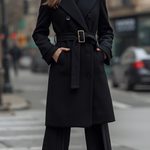
A belted wool coat is the safest choice, because the belt keeps its shape when the dress underneath is loose, and it won’t squash a bow or a ruffle.
Our guide to winter coats that look sharp over everything underneath goes deeper on shapes.
A puffer works for the cold commute if you carry your dress shoes and change at the door.
Whichever you pick, put the coat on over the dress the night before and look at the hem in a mirror.
It takes 2 minutes and saves a morning of changing.
A top coat in a neutral like camel, charcoal or navy goes over every dress in your closet.
A bright coat is fun, and it works best when the dress underneath is a quiet one.
If you can only buy 1 coat this year, buy the neutral.

The Knit Midi: Warmest, and Easiest to Wear
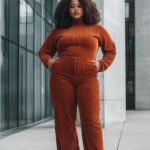
A knit midi dress is the warmest of the lot, and it needs the least help, which is why I’d pick it first for a long day.
A ribbed or chunky knit holds its shape, covers your arms and works with every boot style.
The neckline matters more here than in a thin dress, because a bulky knit with a high neck and a long scarf turns into a lot of fabric near your face.
If your dress has a crew or turtleneck, wear a thin chain or nothing, and skip the scarf.
If the neckline is a V, a scarf in a thin weave fills it in and adds warmth.
A belt at your narrowest point stops a knit from reading as a tent, and it takes about 10 seconds.
That’s the whole trick.
One Midi, Three Outfits This Week
Here’s how a single knit midi covers a whole week without repeating itself.
It’s the cheapest way to make 1 dress feel like 3.
On a work day, pair it with 60 denier black tights, ankle boots and a belted camel coat.
That’s the plain, polished version, and it works in any office that has a heater.
For the weekend, swap to knee-high boots and a puffer, and skip the belt so you can move.
On a party night, add a blazer, sheer 20 denier tights if the venue is warm, and heels you can stand in for 3 hours.
The dress doesn’t change.
The tights, boots and top layer do, and each swap takes under 5 minutes.
If you don’t like what you see in the bathroom mirror, change 1 thing, not 3.

The Satin or Slip Midi: For Parties, With a Layer
A satin midi is the dress everybody wants in December, and it’s the coldest one to wear.
Genuinely.
The fix is layers you can take off.
A fitted knit or a cropped cardigan over the top, a long coat over that, and opaque tights underneath turn a summer dress into a winter one.
For a party, I’d pick the layer first and the dress second, and the holiday party dress ideas have plenty of dresses to try it on.
If the cardigan or blazer looks good with the dress, you can keep it on all night, and you’re not shivering for the photos.
Wear heels you can stand in for 3 hours, and pack a few bobby pins in your bag if your hair is up, because a coat collar will move it.

The Small Pieces, and the Night Before
A belt, a scarf and a bag are the 3 small things that make a winter midi look dressed.
A belt gives your dress a waist under a coat, and a thin one keeps the coat from bunching.
A scarf in a color from the dress, or one shade lighter, ties the top half together.
A bag with a long strap keeps your hands free for gloves.
Keep the metal consistent: gold buckle, gold earrings and a gold bag clasp, or all silver.
Mixed metals work when you mean them, and look accidental when you don’t.
Pretty much every outfit that looks off in a photo has 1 piece that’s fighting the rest.
Lay out the whole outfit the night before, tights to scarf, and try it on once with the coat.
Check the tights for runs, steam the dress if it’s creased, and look at the hem against the boot in a full-length mirror.
That’s the only way to catch the 3 mistakes above, which are tights too thin, a hem fighting a boot, and a coat shorter than the dress.
If you can’t decide between 2 dresses, pick the one that works with the warmer tights.
A cold day is a lot less fun in the prettier outfit.
Building the outfit from scratch?
I’d spend in this order.
Start with 2 pairs of 60 denier tights, because they get worn the most and they’re the cheapest fix.
Next comes the coat, since it’s the piece everyone sees first.
Boots come last, because a boot you already own with a clear hem gap beats a new pair that fights the dress.
One last check: stand in front of a full-length mirror with the coat open and the coat closed.
Both views should look finished.
If the closed coat hides the dress completely, you’re wearing a coat, not an outfit, and that’s fine for the bus.
It’s not fine for the party.