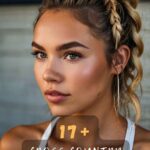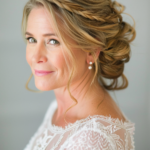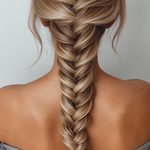
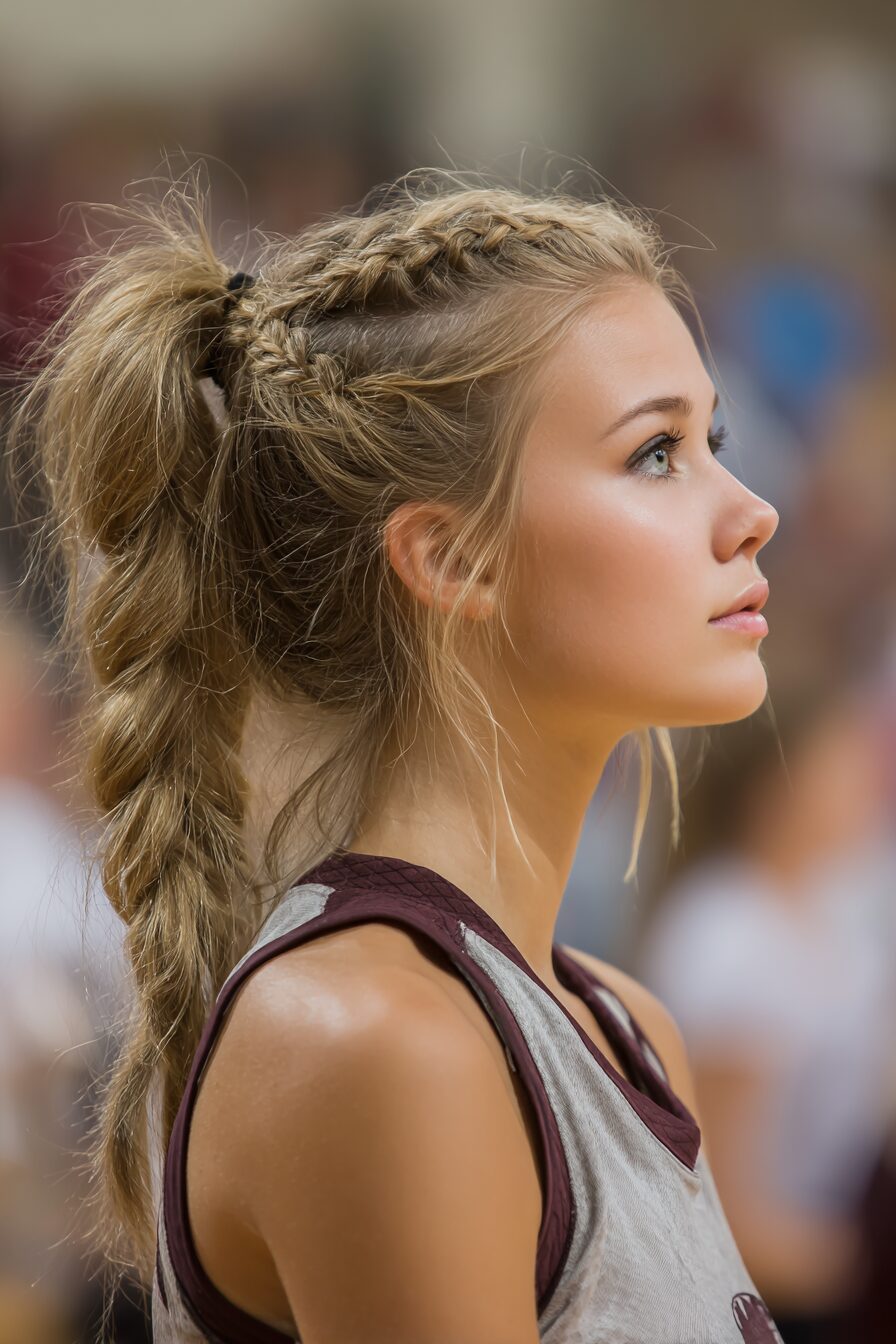
The best volleyball hairstyles keep hair off your face and neck through dives and sweat, and they’re quick to fix between sets.
Dutch braids, Double French Braids and a pinned twisted crown hold best.
A high ponytail with a braided wrap and a low braided bun come next.
A half-up top knot, a messy bun, space buns, a fishtail and a braided headband look great, but they need more fixing once you’re moving.
Each one below comes with the step that makes it hold, and the spot where it usually gives up.
Two things help every style on the list.
Hair that isn’t freshly washed and slippery grips better.
And bobby pins hold better with the ridged side against your scalp.
Lift Your Ponytail With a Hidden Braided Wrap


Most guides treat the braided wrap ponytail like the braid is the star.
It’s not.
Placement is.
Gather your hair right at the crown, the highest point of your head, not down near the nape.
That height is the whole trick.
A pony set too low feels secure in the mirror, but on a jump serve that lower base bounces hard, and bounce is what loosens everything underneath it.
Once the height’s right, take a section about 1 inch wide from the front and do a basic three-strand wrap braid around the base.
Finish by crossing two bobby pins at the braid’s tucked end, not just jabbing one pin straight down.
That cross is what keeps the tail from working itself loose over a long rally.
Use an elastic without a metal joint, and wrap it one more time than feels necessary.
A ponytail that slips usually slips at the elastic, not at the braid.
If your hair is very long, braid the tail too: a long loose tail whips around on every jump, and a braid keeps it in one piece.
Honestly, the braid’s just decoration hiding your elastic.
Height does the actual work.
Dutch Braids Built for Diving and Scrambling

If I had to pick one style off this entire list to trust for a full match with dives, scrambles, floor contact, the whole mess, it’s this one.
Dutch braids are the rare style that survives contact without you needing a mid-game pin check in the huddle.
Start the braid within 1/2 inch of the hairline.
Any further back and you lose the grip point that keeps the front from sliding forward into your eyes mid-dig.
Technique matters more here than almost anywhere else on this list: cross each outer strand under the middle one, not over it.
That’s the difference between Dutch and French, and mixing them up is the usual mistake.
Crossed under, the braid sits raised on top of your hair, and the loose tail is what needs real pinning.
Otherwise the tail is the part that catches on your jersey collar or another player’s arm.
Pin the finished tail flat against the head with two crossed pins at the end.
It takes longer than a plain ponytail.
Worth it.
For an early game, braid the night before and sleep in them.
Second-day hair has more grip than freshly washed hair anyway, so the braids hold better in the morning than they would done fresh.
Space Buns Look Playful But Test Your Patience Mid-Set

I’ll say the unpopular thing: space buns are the most overrated pick on this entire list for actual play.
They’re adorable for a warmup lap or a drill day.
For a real set with dives?
I wouldn’t bet on them.
Most tutorials skip one detail that actually matters here.
Center part from forehead to nape first, and position each bun directly above the ear, not up at the crown like a lot of photos show.
Twist each section clockwise before you wrap it into the bun, then secure with two crossed pins per bun, four pins total.
That twist tension before wrapping is what actually holds these, not the symmetry people obsess over.
Even with perfect symmetric placement, the two sides rarely carry even weight once you’re moving, and a mistimed dive puts all the stress on one bun.
It loosens first, then sags.
If you love them anyway (they are cute), braid each half before you coil it.
A braided bun gives the pins more to grab than a smooth twist, and it keeps its shape longer.
Fine for a casual Saturday practice.
Not my pick for anything with real stakes.
Low Braided Bun Keeps You Polished Between Sets


This one’s underrated (honestly), and I think it gets passed over because it reads as more “office day” than “court day.”
But for taller players doing heavy net play, the low profile is an advantage.
It doesn’t sit up high where it could catch on the net or get grabbed during a scramble at the line.
Braid the full ponytail length using a standard three-strand technique, then coil that braid counter-clockwise against the nape.
Pinning is where people mess it up.
A single center pin through the middle of the coil is why low buns are often the first style to come loose despite looking perfectly neat at the start.
Instead, pin at four points around the coil’s perimeter, basically treating it like you’re anchoring a wheel, not stabbing a dart.
It’s a little more pinning, and it’s the difference between a bun that holds through three sets and one that’s drooping by the second.
Before warmups, give your head one hard shake.
If the coil shifts anywhere, that’s where the next pin goes.
It also sits well under a visor if you play outdoors.
Half-Up Top Knot Splits the Difference on Hot Days


This is the fastest redo on the whole list, and if you’re rotating in and out of play, that speed matters more than people give it credit for.
Part horizontally about 2 inches above your ear line to separate the top section from the bottom.
Twist that top section before wrapping it into a knot at the crown, and keep the wrap loose enough that it pulls free and redoes fast between sets.
Tradeoff: the loose bottom half sticks to a sweaty neck in a humid gym.
Every single time.
If the gym has no air flow in summer, this one gets annoying fast.
People mess it up by leaving too much hair down, more than the bottom third, which kind of defeats the whole point of a half-up style to begin with.
Keep it to that bottom third and it actually earns its spot as a quick, serviceable in-between option.
Keep a spare elastic in your bag.
When the set gets serious, the loose half goes into a low ponytail under the knot in a few seconds, and you’re back to a full-game style.
Fishtail Side Braid Earns Its Fuss

It looks intricate, and it takes about as long as it looks.
That’s my honest take on the fishtail.
This is not a between-set fix.
This is a pre-match style you commit to before you ever step on the court.
Create a deep side part first, then divide into two large sections.
Small outer pieces get crossed into the opposite section, one after another.
It takes a lot longer than a plain braid, so start early.
Before you play, flip the finished braid behind your shoulder so it doesn’t swing forward in a serve-receive stance, because it will swing if you don’t.
Nobody tells you the other thing: a fishtail that’s starting to loosen looks almost exactly like the intentional “undone, piece-y” look it’s supposed to have.
So you can’t always tell at a glance whether it’s failing or just styled that way, which is a real problem when you’re trying to do a quick visual check between points.
So braid it a little tighter than you want it to look.
It loosens on its own as you play, and by the last set it’s at the undone look you were after anyway.
Twisted Crown Pairs Face-Framing Twists With a Low Tail

This is my strongest recommendation on the whole list for anyone who fights flyaways or sweats at the temples first.
Twists basically function like a built-in headband, holding the hairline down without an actual headband sliding around.
Start each twist about 1/2 inch from the center part at the temple, twisting back toward the crown.
Pin the twisted sections flat against the scalp before you gather everything into the low tail at the back, this order matters.
Use three to four pins total along the twist line, and cross two of them in an X where the twists meet the tail, because that’s where the pull is strongest.
Skipping those pins because “the twist will hold itself” is the mistake that ruins this one.
It won’t.
One dive and the whole crown section slips loose, usually all at once, which is more annoying than if you’d just worn it straight back to begin with.
Pin it properly and it’s genuinely one of the sturdier options here.
It’s also the style to pick if you like a headband for play.
The twists hold the hairline, so the headband sits on top as a backup instead of doing all the work and sliding back every time you jump.
Double French Braids Win on Long Match Days

Least glamorous pick on this list, no question.
It’s also my honest choice if I only get to do my hair once before a full day of matches, warmups through finals.
Double French braids are forgiving in a way almost nothing else here is.
Technique’s simple but unforgiving if you rush it: pick up new hair roughly every inch to keep the plait consistent, and keep each braid tight against the scalp instead of letting it balloon out at the crown (that ballooning is the thing that makes braids look sloppy after 3 hours, even when the ends are still perfectly tied off).
Tuck the tied ends under at the neckline so they don’t flap loose during play.
If your hair is layered, the short layers at the nape escape first, so smooth them in with a little gel before you braid.
Braid loosely near the crown and you’ll see visible sagging by the second set, no matter how good the ends look.
Not the cutest style for a photo.
Most practical one for a day that actually demands something from your hair.
And when you take them out after the last match, you get waves for free.
Messy Bun Trades a Little Security for Speed

Fine for warmups.
Fine for casual practice.
My vote is to skip it for anything involving dives, because the effortless look isn’t worth what it costs you in actual hold once you’re on the ground reaching for a ball.
Technique difference from a sleek bun is smaller than people think: twist the gathered ponytail only once before wrapping it, instead of the tight double-twist a sleek bun needs, and pull face-framing pieces only from the temple area, not from the crown (pulling from the crown is what makes a “messy” bun collapse into an actually messy, falling-apart bun).
Almost everyone assumes “messy” means fewer pins.
It doesn’t.
You need the same pin count as a sleek bun, just spaced a little looser.
Skip one or two pins because the look’s supposed to be casual, and you’ll be re-pinning it by set two.
If you still want it for a game, put the messy bun on top of a Dutch braid that runs up from the nape.
The braid takes the stress, and the bun can stay as loose as you like.
Braided Headband Leaves Length Loose Where It Shouldn’t Be

Least practical of the ten for real rallies, and I say that as someone who genuinely likes how this one looks.
Problem isn’t the braid part, it’s that the rest of the hair is just loose, swinging around behind it the whole time you’re playing.
Section hair from ear to ear across the forehead in a U-shape, then braid across using a Dutch, under-over, technique for extra hold right at the hairline.
Secure the braid’s end behind the opposite ear and leave the rest down, which is exactly the part that works against you.
That loose length still swings during play and usually needs a low ponytail as backup just to make it functional at all.
Mistake is treating this as a full-match style, when really it’s a short-drill or pre-practice look, something you’d wear to warm up or to a team photo, not something you’d trust through an actual set.
If you want it for a full set anyway, braid the headband, pull everything behind it into a low ponytail, and pin the braid’s tail over the elastic.
You keep the look, and nothing swings.