
Brown has a funny reputation.
On one person it reads old money, and on the next it reads tired school uniform, even when the two of them are wearing almost the same shade.
So what’s going on?
In my experience it comes down to how many browns you mix, what you break them up with, and whether the clothes fit the way they were cut to.
I’ll show you with one mocha suit worn five ways, plus a cognac dress that breaks a rule I’m very happy to see broken.
Start With One Brown, Head to Toe

If anyone asked me why mocha works, this is the photo I’d hand them.
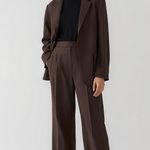
Blazer and pleated trousers, same exact shade.
Your eye reads one long line from shoulder to ankle and doesn’t stop anywhere, which is why a matching suit looks pricier than a brown blazer with brown pants that are almost (but not quite) the same color.
Almost-matching is what looks cheap.
You’d never notice it in the store, and you’ll notice it in every photo afterward.
Now look at the white top.
It puts something bright right by her face, so all that mocha doesn’t wash her out, and you can do the same with a cream tee or a white shirt collar.
One fine pendant necklace, and that’s it for jewelry.
If you love a set that does the thinking for you, my two-piece set outfits post goes deep on that.
Cognac Plus Black Is Fine, Actually

You’ve probably heard that brown and black never go together.
I don’t buy it.
Here’s a warm cognac shirt dress with a leather look, short cuffed sleeves and a row of shiny metal buttons, belted at the waist in a deeper brown so the waist shows without adding a third color, and then, sitting on the ledge beside her, a black quilted bag on a chain.
Clash?
Not even a little.
That bag grounds the whole outfit and makes the cognac look richer next to it.
My line is one black piece, like a bag or a boot.
Black on top, brown on the bottom and black shoes, and you’re back to looking like you got dressed in the dark.
Notice her rings, the thin bracelet and the little hoops, too.
All small, so a busy dress doesn’t get busier.
Pressed Creases Do the Expensive Part

Back to the mocha suit, closer up.
Look at those trousers.
A wide waistband sits high and closes with a button tab, no belt needed, and down each leg runs a sharp pressed crease.
Honestly, that crease is doing more for her than any label could.
Pressed trousers look tailored; unpressed ones look like pajamas in a nice fabric.
So if your suit trousers have a crease, keep it.
A steamer brings it back in about 5 minutes, and an iron with a pressing cloth does it even sharper.
And tuck the top all the way in, like she did, so you can actually see that high waist.
A half-tuck here would hide the best part.
(She’s wearing a watch, too, which is a nice quiet touch with brown.)
Blazer Length Changes the Whole Suit

Here’s the back view, the one most of us never check.
Long blazer.
It covers the seat of the trousers and ends low on the hip, with a flap pocket right where her hand falls.
With trousers this high-waisted, a blazer that stops at the waist tends to make the whole suit look boxy and short, and this length keeps everything long and calm instead.
When you try a blazer on, turn around and check the back in a second mirror before you look at anything else.
Wherever the hem stops, it draws a line, so you want that line below your widest point, not right on it.
Shortening a blazer is normal tailoring work, but there’s rarely enough fabric to make one longer.
I’d always err long.
White Sneakers Turn It Into a Weekend Suit

Same suit, its most casual day, and I kinda love it the most.
White sneakers instead of heels and the whole mood changes.
The trousers stop at the ankle, so nothing drags or bunches over a flat shoe.
I’d want about 1 inch of ankle showing with sneakers.
Less than that and the hem sits on the shoe and wrinkles; more, and it starts to look like your trousers shrank in the wash.
And see how the white sneakers repeat the white of the top?
That ties the two ends of the outfit together without you having to think about it.
It’s the version I’d wear to brunch or on a long travel day.
For a softer, less suited way into brown, there’s lots of it in my brown suede jacket outfits, too.
Open, Loose, and Easy

Last one, and it’s how I’d actually wear this blazer most days.
Open, a little oversized, over the white top.
Her sleeves end right around the wrist, and the shoulders sit where her shoulders are, which is the part you should buy for.
Shoulders are the hardest and priciest thing to alter on a jacket, while sleeves and length are pretty much routine work for a tailor.
So if the shoulders fit you, take it home, even if the sleeves run 1 or 2 inches long.
Curious why outfits like this read as expensive with zero logos?
My quiet luxury outfits post is all about that.
One more thing if your suit is wool: The Woolmark Company’s care advice is to hang woven wool on a shaped or padded hanger and give it 24 hours of rest between wears.