Most bad sweater outfits come from one mistake, and it isn’t the sweater.
It’s what goes under it.
A chunky knit already brings a lot of bulk, so when the bottom half is just as big, the whole outfit turns into one soft blob.
So this isn’t a list of twenty cozy combos.
It’s how I decide what goes with a knit, based on how heavy the knit is, plus the one care habit that keeps a good sweater looking good past November.
Cable Knits Want Something Slim Underneath

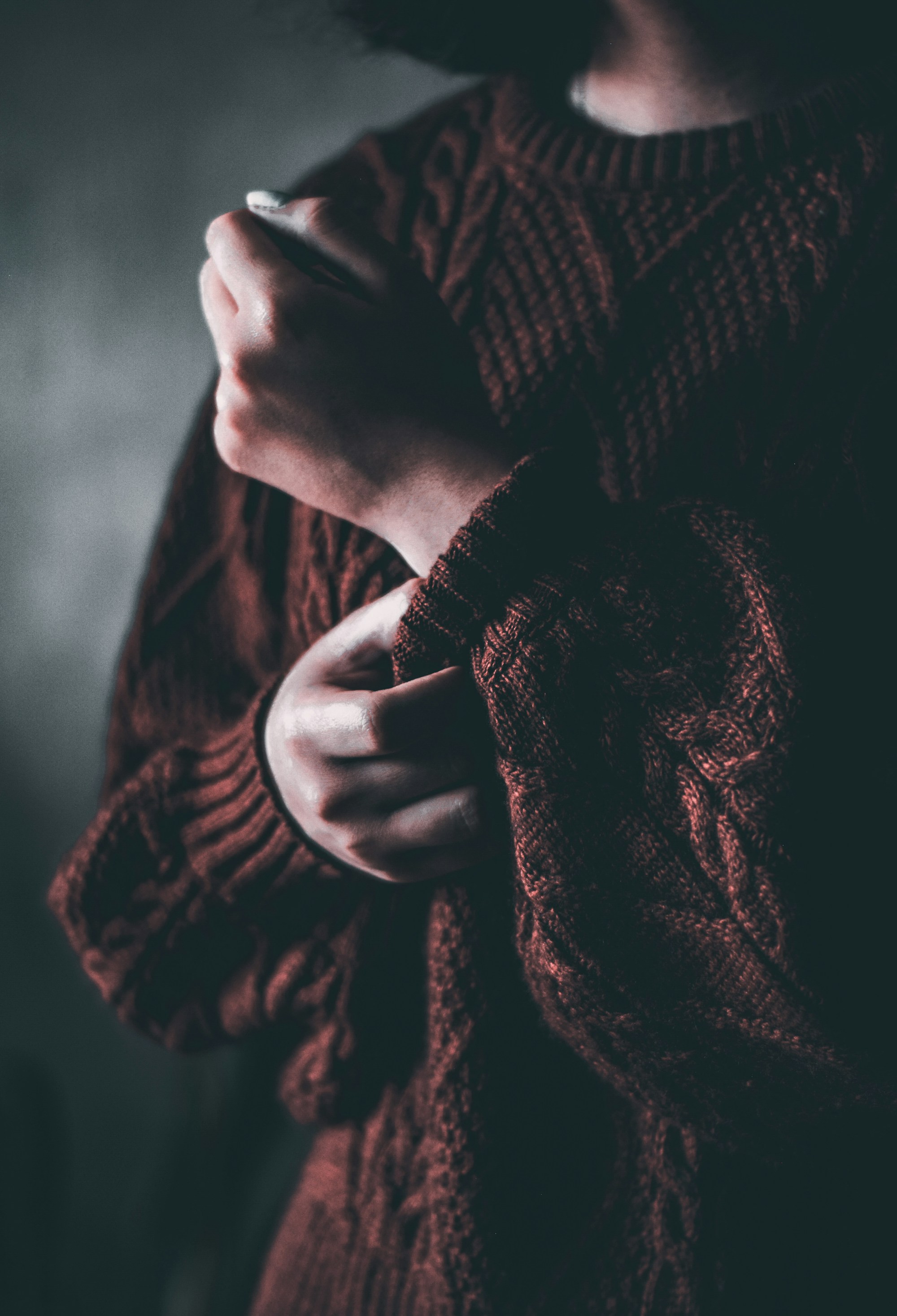
This rust cable knit is the kind of sweater I’d build a whole fall around.
Look at how it’s cut, though.
The shoulder seam drops way down the arm, the sleeves run past the wrist, and the ribbed cuffs bunch up at the hand.
That’s a lot of fabric.
So I keep the bottom half plain and close to the leg: straight dark jeans, a slim black trouser, or a knit midi skirt in a darker shade.
Hear me out on the wide-leg jeans thing.
I love them, but with an oversized cable knit left loose, they make you look like you’re wearing a duvet.
If you really want wide legs, tuck the front of the sweater (more on that below).
And if you’re more of a skirt person, I’ve got sweater and skirt pairings that work the same way, with one fitted half and one roomy half.
What Those Cables Actually Are

Get close and you can see the pattern is more than one braid.
There are cables, there are diamonds, and in between there’s a pebbly fill called moss stitch.
A cable is honestly simple once you know it’s just a few stitches crossed over their neighbors, again and again, so they twist like rope.
Sweaters knit like this are called Aran sweaters (or Aran jumpers), after the Aran Islands off the west coast of Ireland.
The classic version is cream, knit from undyed wool the islanders called báinín, and the original ones were made with unwashed wool that still had its lanolin in it, which helped shed water.
You’ve probably heard the romantic story that every island family had its own secret pattern.
Turns out that’s a misconception, not history.
I kinda like that.
It means you can pick a cable sweater because you love the pattern, not because it supposedly tells a story.
A deep rust like this one isn’t the traditional color, and to me that’s exactly why it works with jeans and boots on a normal Tuesday.
Tuck It, Then Belt It

This is my favorite trick for a chunky knit, and it costs nothing.
The teal sweater here is thick, with big balloon sleeves gathered at the cuff.
Left loose, it would cover her hips and cut her legs off at the worst spot.
Tucked into high-waisted black pants with a plain black belt and a silver buckle, it suddenly has a waist.
The sleeves stay big and dramatic, and the rest looks sharp.
A full tuck works with a thinner knit.
With a thick one, I’d only tuck the front 3 or 4 inches and let the back hang, because a whole chunky sweater stuffed into a waistband makes a lumpy line under the fabric.
Push the tucked part down far enough that the belt shows.
That little strip of leather and metal is doing more work than it looks like.
Mustard, Cream or Camel

If you only buy one knit this fall, I’d pick cream.
It goes with blue denim, black, brown, gray and every coat you already own, and it makes the rest of the outfit look a bit brighter near your face.
Mustard is the fun one.
I like it with dark denim or black jeans, since both calm it down, and I’d skip it with anything else yellow-brown.
Camel is the grown-up one, and it looks expensive next to cream, white, or a dark brown boot.
All three of these are rib knits, not cables, and they’re wonderful for layering because the rib lies flatter than a cable does.
For a whole wardrobe built around a few colors like these, my fall capsule wardrobe post does the planning for you.
Roll the Cuff Once

Every sleeve in this pile is rolled once, and that’s not an accident.
A rolled cuff shows your wrist, and a bit of wrist is what keeps a big sweater from swallowing you.
I’d fold it back once, about 2 inches, so the cuff sits just above the wrist bone.
Push it up any further and it slides down by lunch anyway.
This is also where texture helps.
A ribbed sweater next to a smooth fabric, like a cotton shirt collar peeking out or a satin skirt, looks planned.
Two chunky textures at once (a cable knit with a chunky scarf, say) is pretty much the blob again.
I keep one texture loud and the rest quiet.
If chunky isn’t your thing, there are plenty of other sweater shapes in my soft sweater styles roundup.
Fold Your Knits (Yes, Even This One)

I love this photo, and I’d still never store a sweater like this.
A knit on a hanger slowly stretches out at the shoulders, and you end up with those little hanger bumps that never quite go away.
The Woolmark Company’s own care advice is to fold knitted garments and keep them in a drawer, and to save the hangers for woven wool, like a coat or a blazer.
They also say to rest a wool piece for 24 hours before wearing it again, so the fiber can spring back.
That’s honestly the easiest care rule there is.
Rotating two sweaters through the week makes that easy, and a folded knit keeps its shape way better than one left on the back of a door.
A hanger is fine for 1 or 2 hours of airing out.
Just don’t let your best cable knit live there.