
The first double-breasted blazer I ever owned came off a thrift-store rack for $38.
Navy, gold buttons, a little big in the shoulders (I told myself that was the style).
I wore it twice that whole year.
Every time I tried it on in my bathroom mirror, I looked like I’d borrowed my dad’s jacket for a board meeting.
Turns out the jacket was fine.
I just didn’t know how to wear one.
Double-breasted blazers are all over the stores again this fall, and they’re one of those pieces that look effortless on other people and fussy on you, right up until somebody explains how they work.
There aren’t many rules.
Most of them are about the buttons.
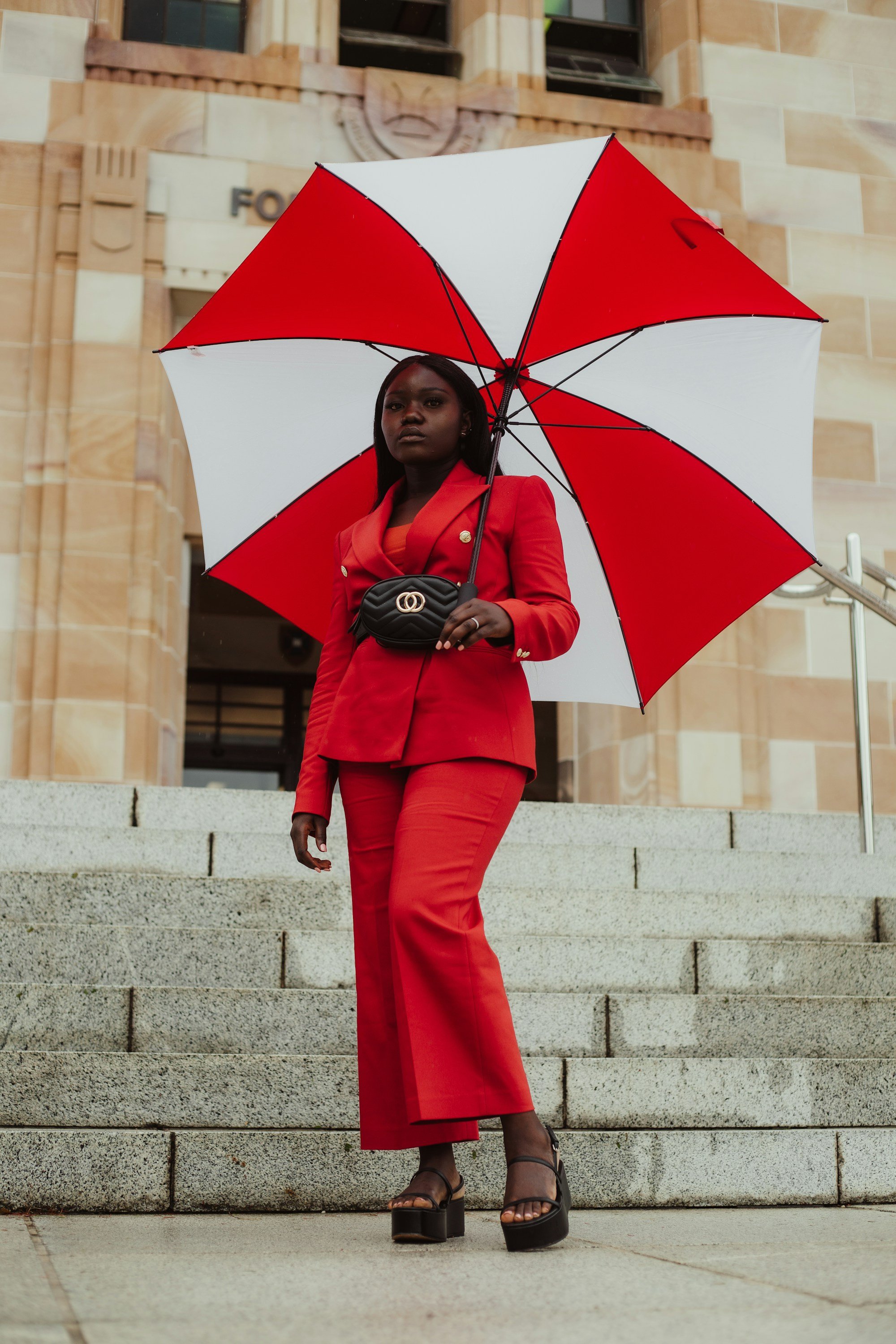
That red suit up top is the whole idea in one photo.
It’s closed at the waist, with gold buttons up at the chest and wide trousers underneath.
I’m not wearing anything that bright to the grocery store (I wish I were that person), but the shape is the shape.
Six Buttons, Two Rows: How to Read a Double-Breasted Jacket

A double-breasted jacket has two columns of buttons, and one front panel crosses over the other.
That overlap is the whole difference from a regular blazer.
Okay, so brands describe the layout with a little code.
The first number is how many buttons are on the front, and the second is how many actually fasten.
Articles of Style, a custom tailor, calls the 6×2 the most common and traditional layout: six buttons, two that close.
So what are the other four doing?
Mostly looking good, honestly.
Oscar Jacobson’s guide explains that on a classic double-breasted, the pair up at chest height is decoration, there for symmetry, and you fasten one of the lower rows.
Six buttons feel like a lot?
Permanent Style likes the 4×2 for exactly that reason.
It drops the decorative pair, so the chest looks cleaner and less bulky.
This style has been around for a while, too.
Oscar Jacobson traces it back to military uniforms and says it has defined classic menswear for the past 150 years.
The black one in that photo shows the layout well.
Its top pair sits wider apart than the buttons below it, so the two button lines lean in toward the waist.
Remember that slant.
It comes back when we get to fit.
Two more things nobody tells you in the store:
- There’s a hidden button inside. It holds the under panel flat so it doesn’t droop at the hem, and Articles of Style says that one should always stay fastened.
- Women’s jackets close the opposite way from men’s. Oscar Jacobson points out that on a man’s double-breasted the wearer’s left side laps over the right, and on a woman’s it’s the right over the left.
That second one matters if you thrift like I do.
Half the good double-breasted jackets at my secondhand store hang in the men’s section, and a men’s one closes “backward” on you.
Nobody has ever noticed on me.
Not once.
Buttoned: Close the Middle Row and Leave the Bottom Alone

Here’s the rule I had to look up three separate times before it stuck (yes, three).
On a 6×2, you fasten the middle row and leave the bottom one open.
According to Oscar Jacobson, that middle row is placed to sit at your natural waist, which is what gives a buttoned double-breasted its hourglass shape.
Opinions are split on the bottom button.
Both Oscar Jacobson and Articles of Style leave it undone so the jacket falls naturally over the hip.
Look at that cream jacket.
Closed, it turns the lapels into one long, deep V from the collar to the waist.
That V is the most flattering thing this cut does, and you only get it buttoned.
Historically, Oscar Jacobson says, double-breasted jackets were always worn buttoned, because the overlapping fabric can look sloppy hanging open.
That’s still my default when I need to look put-together, like a work presentation or a wedding where I barely know anyone.
My one warning about wearing it buttoned: sit down in it before you leave the house.
If it pulls into an X across your stomach when you sit, it’s going to do that all evening, and in every one of the photos.
A look that only lasts for one photo is not a good look.
It has to survive the whole day.
Open: The Easy Way to Dress It Down

Good news for the rest of the week.
That old always-buttoned rule has relaxed, and Oscar Jacobson says a modern cut lets you dress a double-breasted down just by wearing it open.
This is how I wear mine 9 days out of 10 (the tenth is usually a wedding).
Open over a plain tee, sleeves pushed up a little, with jeans.
It reads relaxed instead of corporate.
See how the fronts of that check blazer fall straight down on both sides and frame the white tee?
That’s what you’re going for.
The catch: a double-breasted has more fabric in front than a single-breasted, and when it’s open, that extra fabric flaps around.
Two fixes that work for me:
- Pick a softer, lighter jacket for wearing open. A stiff, heavily padded one swings around like a cape.
- Put your hands in your pockets now and then. It sounds silly, I know. But it pulls the fronts back so they hang straight.
If you want more ways to wear a blazer open with denim, I rounded up my favorite blazer and jeans combinations.
The Fitting-Room Checks I Do Before I Pay

A double-breasted is less forgiving than a regular blazer.
Permanent Style, a menswear site, goes as far as saying most off-the-rack double-breasted jackets are less flattering than single-breasted ones, simply because they’re harder to cut to a standard fit.
So I check five things, in this order, every single time.
It takes about 10 minutes and has saved me from more returns than I want to admit.
Shoulders first.
The seam should sit right at your natural shoulder, where your arm starts.
Petite Dressing’s blazer guide puts it bluntly: if the shoulder seam is above or below that bend, the fit isn’t right.
Check the navy blazer in that photo.
Its seams sit on her shoulder bone and the sleeves drop straight down from there.
That’s the target.
Then the closing row.
Articles of Style says the button stance is the narrowest part of the jacket, so it should line up with the narrowest part of your torso.
Button it.
Fabric pulling into an X around the buttons means it’s too small, and fabric pooling over your stomach means it’s too big.
Sleeves are next.
Stand with your arms down at your sides.
Petite Dressing says a full-length sleeve should end right at the joint of your thumb.
Mine never do.
Ever.
I’m 5′4″ and nearly every sleeve I try is about 1 inch too long, so I just budget for shortening.
Length matters more on this cut than on a regular blazer, it turns out.
Articles of Style says a double-breasted should be slightly longer than a single-breasted so it doesn’t look boxy.
Petite Dressing’s rule: the hem should land just above or just below the widest part of whatever it covers, never right on it.
Last, sit down.
Primark’s blazer guide says to undo the buttons before you sit, then check that the jacket doesn’t ride up or bunch.
Use the fitting-room chair (or the floor, if there isn’t one).
30 seconds, and you know.
On price, Petite Dressing puts a good-quality blazer at around $100 to $200, and says the biggest sales on winter clothes run from late November to January.
Not in a hurry?
Wait.
Seriously.
What Goes Under It Starts With the Neckline

I pick the top by its neckline, usually the night before.
The lapels already make a big V, and whatever goes under it either works with that V or fights it.
What works under a double-breasted, from most casual to dressiest:
- A plain white crew-neck tee. Look at that close-up: the round neckline sits inside the V, and two thin necklaces fill the gap. This is my most-worn version by a mile.
- A thin, fitted turtleneck. It’s my fall default, but it has to be fine-knit, like the one below. A chunky sweater adds bulk right where the jacket already has two layers of fabric.
- A silky camisole or a simple bodysuit, for evenings.
- Nothing at all, with the jacket buttoned, like the cream suit above. That one’s for a wedding, not a Tuesday.

Skip anything with its own big collar or a busy neckline.
Ruffles on top of lapels on top of crossed fronts is too much going on in one small space.
A collared shirt can work if you like that look.
Articles of Style’s rule is that the jacket collar should hug the shirt collar with no gap, with a little of the shirt collar showing above it at the back.
Jeans or Trousers, and When a Short Skirt Works

Jeans are where a double-breasted stops looking like work.
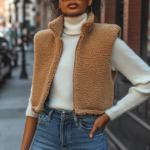
Straight-leg jeans, like the ones under that camel blazer, are the easiest match because the line stays clean from the jacket hem to your ankle.
One rule fixed my proportions for good: one piece is roomy, the other is fitted.
Petite Dressing gives the same advice for oversized blazers, saying to wear them with more fitted pieces so you’re not lost in fabric.
A long, loose blazer over baggy jeans can work on a tall person.
On me it looks like a tent.
A nice tent, but still.
Wide-leg trousers are the dressier route, and a matching suit like the red one up top is the dressiest of all.
With wide legs, watch the hem, because too short throws off the whole outfit.
I wrote up wide-leg trouser outfits and the hem each one needs, since that part took me years to get right.

A short skirt is honestly the fun one.
That photo is pretty much my fall uniform for a weekend dinner: a check blazer over a graphic tee, with a black mini and lace-up boots.
What makes it work is length.
Keep the blazer about as long as the skirt, so the two read as one shape instead of two hemlines fighting each other.
Shoes: From White Sneakers to Heels

Your shoes decide how dressed-up the outfit reads, more than the jacket does.
White sneakers are the fastest way to make a double-breasted casual.
That taupe suit with plain white sneakers is exactly what I’d wear on a Saturday.
Keep them clean, though (I wipe mine down before I leave).
Scuffed sneakers under a tailored jacket look like an accident.
Boots pretty much carry me from October to March.
Chelsea boots go with slim jeans, and chunky lace-up boots go with a short hem.
The photo below takes it all the way, with an oversized blazer worn as a dress over sheer black tights.

Heels belong with the dressy versions, like the buttoned suit or wide-leg trousers.
Petite Dressing has a tip for petite women who love a long blazer: wear it with high heels to add a bit of height.
That one works for me, mostly.
Platform sandals like the ones in the red-suit photo do the same job with a lot less wobbling.
Not sure your heels will last the day?
When I’m getting ready for something long, I walk around the apartment in them for 15 minutes the night before.
Anything that hurts by minute ten stays home.
Which Double-Breasted Works for Your Shape

Here’s the honest part.
A double-breasted adds visual width up top, and Permanent Style explains why: the lapels get pulled across the body in a strong diagonal, and the buttons make horizontal lines.
On someone with narrow shoulders that’s a gift.
On someone broad, it can be a lot.
The button layout changes that.
Permanent Style says that moving the closing buttons lower makes the lapel longer and more vertical, which is what a 6×1 or 4×1 does.
40plusstyle adds that a double-breasted can add bulk and is a bit harder to wear, and that the flattering ones have buttons that start wide and taper in at the waist.
Petite?
Petite Dressing says length is the thing to get right.
Long, oversized blazers can overwhelm a petite frame, and shorter or even cropped styles tend to flatter more.
That long check blazer in the photo works on her because the jeans underneath are slim and the boots are simple.
At 5′4″, I’d go shorter or add heels.
For shoulders, Petite Dressing’s advice is to skip heavy structure and shoulder pads if yours are broad, and to go for structure and padding if they’re narrow, because it adds balance.
Primark’s guide puts it in body-shape terms.
For a straight shape, a double-breasted or fitted style adds definition.
For an inverted triangle, avoid bulk on the shoulders.
And that thrifted navy jacket from the beginning?
It finally got worn this fall, open, over a white tee with straight jeans.
After 3 years in my closet, it turns out the jacket was never the problem.
For more classic pieces that look expensive without a single logo, my old money outfits are the next stop.