I used to grab sunglasses off a spinning rack at the checkout counter and just… hope for the best.
Every single summer, I’d end up with a pair that looked amazing on the display and absolutely unhinged on my actual face.
And I never knew why.
It wasn’t until my friend — who studies fashion like it’s her religion — gently pointed out that I kept choosing frames that fought against my bone structure instead of working with it.
That one conversation changed everything for me.
Suddenly, getting dressed felt less like a guessing game and more like something I could actually understand.
So I put together everything I’ve learned — the trial-and-error, the research, the full-length mirror moments — into this guide just for you.
First, Let’s Figure Out Your Face Shape

Before we even talk about frames, you need to know your starting point.
And honestly?
This part is kind of fun.
Pull your hair back, stand in front of a mirror, and really look at the outline of your face.
You’re looking at a few things: the width of your forehead compared to your jaw, the length of your face, and whether your features feel soft and rounded or more defined and angular.
Most faces fall into one of these categories: oval, round, square, heart, oblong, or diamond.
If you’re somewhere in between two shapes — which is super common — just note which features feel most dominant.
When I did this myself, I kept thinking I had a round face, but my jawline is actually pretty defined.
Turns out I’m closer to square, which completely changed which frames I should be reaching for.
Don’t overthink it.
A rough idea of your shape is all you need to start making smarter choices.
The Oval Face: You Can Wear Almost Anything (Lucky You)

If you have an oval face, you genuinely hit the genetic lottery when it comes to sunglasses.
Your face is slightly longer than it is wide, with a forehead that’s just a little broader than your jaw and soft, gently curved cheekbones.
Almost every frame style complements this shape, which is both a blessing and a tiny curse because the options can feel overwhelming.
That said, my personal recommendation for oval faces is to lean into oversized styles.
Big square frames, wide aviators, chunky cat-eyes — they all look incredible.
They bring just enough structure to balance those softer curves without competing with them.
The one thing I’d steer away from is frames that are too narrow or too small for your face.
When the frame doesn’t span the full width of your face, it sort of disappears — and you lose that gorgeous balance that your face shape naturally offers.
If I had an oval face, I’d honestly own five pairs of sunglasses just because I could.
Embrace the flexibility.
It’s a rare thing.
The Round Face: Add Angles, Always

Round faces are so pretty — soft, symmetrical, youthful.
But the goal with frames is to create some contrast against all that softness.
You want to borrow a little edge.
Angular frames are your absolute best friend here.
Think rectangular shapes, sharp square frames, or anything with a strong geometric vibe.
These styles draw the eye horizontally and vertically, which makes your face appear a little longer and more defined.
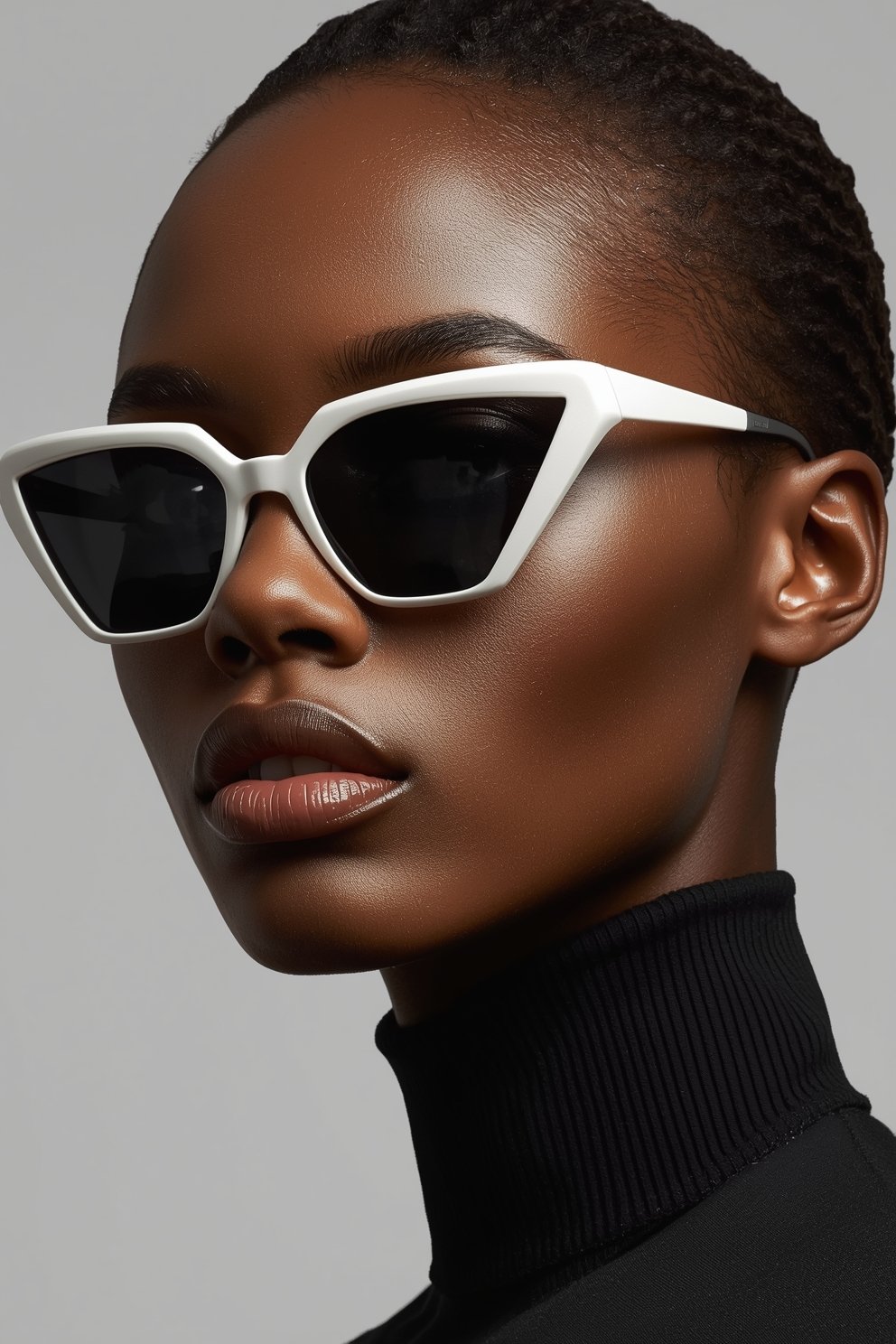
Cat-eye frames also work beautifully on round faces because that upswept corner lifts the whole look.
What I’d avoid are perfectly round frames — wire-rimmed circles, round John Lennon styles, anything that mirrors the shape of your face.
Wearing a round frame on a round face just sort of amplifies the roundness, and it can feel a little unbalanced.
Also skip tiny frames.
When I tried a pair of small oval sunglasses once — I looked like I was wearing sunglasses from a children’s costume kit.
Not the vibe.
Go bold, go angular, and honestly, go big.
You can handle it.
The Square Face: Soften Those Gorgeous Strong Lines

Square faces have the most enviable jawlines, I’m sorry, but it’s true.
That strong, defined jaw paired with a broad forehead and cheekbones that are roughly the same width — it’s a really striking combination.
But the key to sunglasses for square faces is softening all that structure, not matching it.
Round frames are your go-to.
Classic round lenses, soft oval shapes, anything that introduces a curve.
The contrast between your angular face and a curved frame creates this really lovely visual balance.
Aviators also work really well — that slight teardrop shape has just enough softness to complement a strong jaw without looking too feminine or too delicate.
What I’d skip are super boxy, rectangular frames.
They sort of echo the angularity that’s already there, and everything starts to look a little rigid and heavy.
When my friend with a square face switched from sharp rectangular frames to a pair of soft round tortoiseshell sunglasses, it completely transformed her look.
Same face, totally different energy.
Warm, effortless, cool.
That’s what the right frames can do.
The Heart Face: Balance That Beautiful Wide Forehead

Heart-shaped faces have a wide forehead that tapers down to a delicate, narrow chin.
It’s a gorgeous shape — very classic, very feminine.
But frames can either highlight that contrast beautifully or make it look a little top-heavy.
The goal is to draw attention downward and add some width near the lower half of your face.
Bottom-heavy frames are ideal for this.
Look for styles where the frame is wider or more detailed at the bottom — like a slight reverse cat-eye, or a frame with a thicker lower rim.
Aviators are another great option because the teardrop shape widens toward the bottom of the lens, which mirrors and balances your chin line so well.
Light-colored or rimless frames also work beautifully on heart shapes.
They don’t add visual weight up top, where you already have the most width.
I’d be careful with oversized cat-eyes that flare dramatically upward.
They tend to exaggerate the width of the forehead, and the whole thing can start to feel unbalanced.
You’re working with such a pretty shape — the right frame just needs to let it breathe.
The Oblong Face: Add Width, Create Curves

Oblong faces are longer than they are wide, with a fairly uniform width from forehead to jaw and a long, straight cheek line.
The goal with frames here is to add the illusion of width and break up that vertical length.
Big, oversized frames are absolutely your thing.
The wider the frame, the more horizontal emphasis it adds across your face — and that’s exactly what an oblong face benefits from.
Look for frames with decorative details on the temples, bold colors on the arms, or embellishments that draw the eye sideways.
Tall lenses also help because they take up more vertical real estate on your face, which reduces the appearance of length.
Wrap-around styles and shield frames can look really modern and cool on oblong faces too.
What I’d steer away from are narrow, rectangular frames.
They’re too small to add any balancing width, and they can almost disappear against a longer face.
Also avoid anything rimless or super minimalist.
You want presence.
You want a frame that shows up.
Think bold, think wide, think statement.
The Diamond Face: Show Off Those Cheekbones

Diamond-shaped faces are defined by those stunning wide cheekbones — your face is narrowest at the forehead and jawline, with cheeks that are the widest point.
It’s actually a pretty rare face shape, and kind of a showstopper.
The challenge is finding frames that don’t overpower those prominent cheekbones or make the forehead look even narrower.
Oval and cat-eye frames work really well for diamond shapes.
Cat-eyes in particular draw attention upward to the forehead and add width there, which balances out all that cheekbone drama below.
Rimless frames and frameless styles are also gorgeous on diamond faces.
They’re light and delicate enough to complement the face without competing with those natural bone structure highlights.
What I’d avoid are frames that are overly wide at the middle of the lens.
That’s the area of your face that’s already the widest, so adding more width there with a big bold frame right at cheekbone level can make things look a little exaggerated.
Think up, think delicate, think chic.
Your cheekbones are already doing a lot of the work.
Let your frames be a beautiful complement, not a competition.
The Color of the Frame Changes Everything

Once you’ve figured out your face shape and the right frame size, color becomes this really fun final layer.
And honestly?
Frame color is where personality comes in.
If you have warm undertones in your skin — think golden, peachy, or olive — tortoiseshell, warm browns, gold hardware, and earthy amber tones are going to look so cozy and natural on you.
If you have cool undertones — think pink, rosy, or bluish — black frames, silver hardware, jewel tones like deep plum or navy, and clear frames with a cool tint are going to feel more harmonious.
Neutral undertones?
You’re a little lucky — most shades work, but I’d lean toward classic black or clear for everyday pairs.
For lens color, brown-tinted lenses tend to warm up your face and look gorgeous in natural light.
Gray lenses are a little more neutral and modern.
Green lenses give this really editorial, cool-girl feel.
My personal everyday pair has warm tortoiseshell frames and brown lenses.
It goes with basically everything I own, and every time I put them on, I feel like a whole moment.
Lens Shape vs. Frame Shape — Yes, There’s a Difference

This is something a lot of people overlook, and once I noticed it, I couldn’t unsee it.
The frame is the physical structure that holds your lenses.
The lens is the actual tinted piece inside.
Sometimes they’re the same shape — a round frame with round lenses, for example.
But sometimes they’re different, and that difference actually changes how the sunglass reads on your face.
A square frame can have slightly softened, rounded lenses inside — which gives you a more balanced look.
A round frame can have a subtle flat bottom on the lens, which adds just a touch of angularity.
When you’re shopping, try to look at both the overall silhouette and the lens shape separately.
If you have a round face and you pick up frames that look square from far away but have very round lenses inside, you’re not actually getting the angular effect you need.
It sounds a little technical, but it becomes intuitive really fast once you start paying attention.
Hold the frames up, look at just the lenses, and think about what shape is actually touching your face.
My Personal Hacks for Trying Sunglasses On

Okay, real talk — trying on sunglasses in a store can feel kind of chaotic and weirdly stressful.
Here are a few things I do every single time.
First: pull my hair back.
Even a quick ponytail or clip gives me a cleaner view of how the frames interact with my actual face structure.
Second: I step away from the display and find natural light.
Store lighting is designed to make products look good, not to give you an accurate read on how something looks on you.
Third: I take a photo instead of just looking in the mirror.
Something about seeing yourself in a photo versus live reflection gives you a slightly more objective view.
I’ve talked myself out of so many wrong pairs just by looking at the photo and going, “Oh. No.”
Fourth: I put the sunglasses on and then look away from the mirror for a full 30 seconds.
When I look back, my first gut reaction is usually the right one.
Trust that instinct.
It knows.
Here’s my honest truth: the face shape rules are a guide, not a law.
I have a square face, and I own a pair of very round wire frames that technically aren’t “right” for my shape.
And I wear them constantly because they make me feel cool and a little retro and completely myself.
Style isn’t just about what’s flattering on paper.
It’s about what makes you feel something when you put it on.
If you’re drawn to a pair that doesn’t fit the formula — try them anyway.
Sometimes an unexpected frame is the most interesting choice.
Sometimes breaking the rules is exactly what creates a signature look.
The women I find most stylish are never the ones perfectly following every guideline.
They’re the ones who know the rules, understand them, and then wear exactly what makes them feel like the best version of themselves.
So use this guide as a starting point.
Let it give you confidence and direction.
But then trust your eye.
Trust your gut.
And wear what makes you feel like you.