
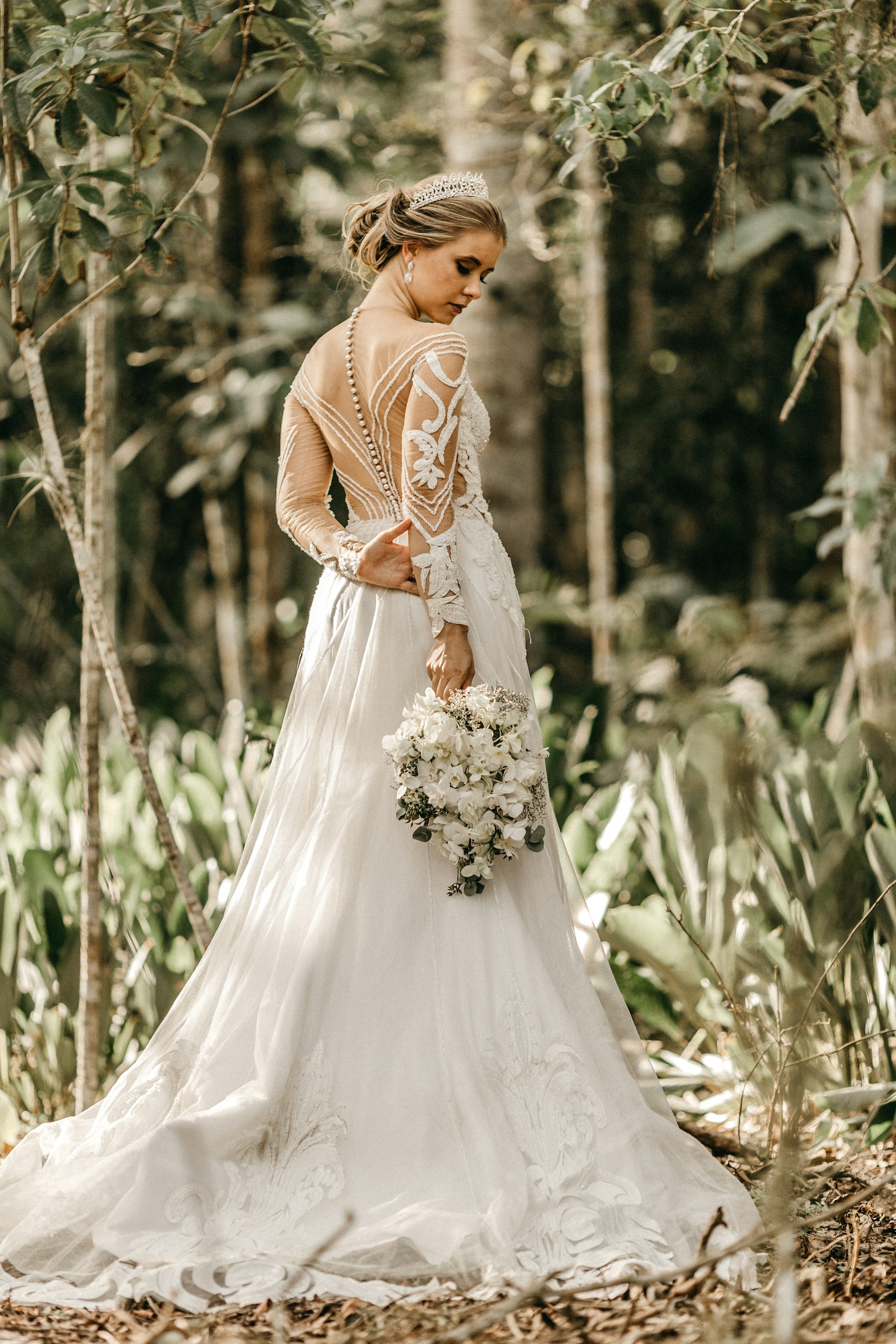

I love a wedding dress that looks like it grew in a forest.
Soft tulle, little flowers climbing up the skirt, sleeves you can see through, maybe a cape that lifts when the wind picks up.
That’s the whimsy look, and it’s all over my Pinterest right now.
It’s also easy to get wrong.
Go too far and you’re a bride in a costume.
Play it too safe and it’s just a nice white dress.
So here’s how I’d shop for it if my wedding were next year: the fabrics, the details, which dress suits which venue, and when you really need to start.
Quick warning first.
I’m not a bridal stylist.
I’m the friend who’s always in the room while everyone’s getting ready, holding the bobby pins and saying the honest thing.
Take all of this in that spirit.
What Actually Makes a Dress Feel Whimsical

Whimsy isn’t one dress.
It’s a feeling you get from a few things working together, and I look for 3 of them.
The dress should move when you move.
It should have some softness you can nearly see through.
And it should have one detail that’s a little bit wild, like flowers or a floating sleeve.
Movement comes first for me.
The dress in this photo looks like plain chiffon with hardly any decoration, and it still feels like a fairytale because the wind can get into it.
A stiff skirt in the same cut wouldn’t do that.
So in the salon, don’t just stand on the little box and stare at the mirror.
Walk.
Turn around fast.
Sit down.
My hot take on every look applies here too: if it only works for one photo, it isn’t good.
You’ll be in this dress for 8 or 10 hours (ceremony, photos, dinner, dancing, the bathroom), and you won’t be standing still for most of them.
Tulle Does Most of the Work

Tulle is the fabric behind nearly all of these dresses.
It’s a very fine netting with tiny six-sided holes, and it takes its name from Tulle, a small town in France once known for lace and silk.
Most of it today is polyester, though you’ll also find silk and nylon.
What matters to you is how it behaves.
One layer is almost nothing.
Stack up layers and you get that cloud shape, and stiff tulle puffs out far more than soft tulle does.
Ask the salon which one you’ve got on.
Soft layers float close to your legs, while stiff ones stand away from you like a bell.

I like the balance in this one, with a lace top over a full tulle skirt.
The top gives your eye something to read, and the skirt stays airy.
It’s a great choice if you want the big fairytale skirt without a dress that’s all sparkle.
One real-life note: tulle snags.
Bracelets, a ring with a high setting, the buckle on your heels.
Take off the sharp stuff while you’re getting dressed, and tell your bridesmaids to do the same before they help.
I’ve watched a 2-inch tear appear from one charm bracelet, and it was not a fun 10 minutes.
Florals That Climb Instead of Cover

Floral applique is the detail most people mean when they say “whimsy.”
These are lace or fabric flowers and leaves sewn onto the dress, and the best ones look like they grew there.
In this photo, white leaves trail down from the neckline and scatter across a tulle skirt.
They thin out as they go down, which keeps the whole thing light.
(And yes, those are mint green sneakers under there.
I love it.)

The other way to go is full coverage, with flowers from the neckline right down to the hem.
It’s more romantic and a lot more dress.
If you love that, keep everything else quiet: simple hair, small earrings, no big necklace.
Here’s what I’d check on the hanger.
Are the flowers placed on purpose, or just sprinkled?
Do they fade out gently over your hips, or stop in a hard line?
(A hard line can look like a sticker.)
If you want more on this, I’ve got a whole post on lace wedding dresses, from the delicate ones to the full drama.
Sheer Sleeves That Still Feel Light

Sheer sleeves are how you get coverage without looking covered up.
The loose, off-the-shoulder kind in this photo is the most fairytale version I can think of.
They sit low on the arm and gather at the wrist, with a few lace flowers floating on the sheer part.

A long, plain sheer sleeve is the quieter option.
It’s great for a church that asks for covered arms, for a cool evening, or if you’d just feel better that way.
You still see skin through it, so it never feels heavy.
Test these in the fitting room, because sleeves are where a dress fights you.
Lift your arms like you’re hugging your tallest uncle.
Then pretend you’re dancing.
Off-the-shoulder styles can pin your arms down, and you’ll want to know that now, not during the first song.
If you love a big sleeve on anything else, my puff sleeve dresses post will make you very happy.
Capes Give You the Drama Without the Train

A cape might be my favorite part of this whole trend.
It’s a long sheer layer that hangs from your shoulders and falls behind you, so you get the sweep of a big train on a much slimmer dress.

The dress in this shot is a fitted lace gown, and the cape does the rest.
Take it away and you’ve got a sleek dress.
Leave it on and she’s stepped out of a storybook.
Some capes are sewn on and some come off, so ask.
One you can unhook before dinner is a lot easier to dance in.
A long train needs a bustle for the party, which lifts it off the floor with hidden buttons or ties.
That’s fine, but it’s one more job somebody has to do for you in a hallway.
A cape that comes off is just gone.
Wind is the one catch.
Outdoors, sheer layers fly around, which is gorgeous in the photos and annoying during your vows.
Ask your seamstress for a small hidden wrist loop so you can hold it down when you need to.
You Don’t Have to Wear White

Peach, blush, soft gray, a dusty blue.
Color makes a whimsical dress look even more like a storybook, and a soft shade still reads as bridal.
The peach tulle here has long sheer sleeves and a train, and it doesn’t need any other decoration.

If full color feels like a lot, start small.
A dusty blue tulle skirt like this one, or a blush lining under white lace, gives you the color from a distance without shouting about it up close.
I’m also into those teal heels.
Whatever shade you’re thinking about, ask for a swatch.
Take it home, hold it under your chin for 10 seconds, and look in the bathroom mirror and then by a window at noon.
My bathroom has terrible light, which is the point.
If a color works there, it works anywhere.
Some blushes disappear on fair skin, and some peaches turn orange under warm bulbs.
Match the Dress to Your Venue and Your Shape

Fairytale doesn’t come in one size.
The bride in this photo is wearing a tiered tulle skirt with a long veil, and all that movement reads as pure romance.
Nobody gets to tell you a certain body can’t have the cloud skirt.
A few basics help when you’re trying things on.
A ball gown has a fitted top with a full skirt that starts at or near your natural waist.
An A-line skims out from the waist in a softer line.
A sheath runs close to the body, and that’s where a cape earns its place.
Try one of each, even if you’re sure of your answer.
Fit changes from dress to dress and brand to brand, so go by the mirror and not by the size on the tag.

And the venue should get a vote.
Long trains pick up dirt and damp at the hem, so a forest or a field calls for less fabric on the ground.
A dress like this one works beautifully there, because the skirt stays simple while the wild bouquet and loose hair bring the whimsy.
If you’re getting married on sand, read my beach wedding dresses post first, because the rules change.
Crowns, Veils and Hair That Last All Day

A flower crown is the fastest way to turn a simple dress into this look.
Fresh flowers are gorgeous, but ask your florist to make the crown as late as they can, especially for a hot day.
Don’t trust a crown to stay put by itself.
I’d use at least 4 bobby pins, crossed in an X over the band on each side, and I’d do a test run the night before.
Shake your head.
Bend over.
If it moves now, it’ll move more after 3 hours of hugs.

If you don’t want anything that can wilt, a crown of pearls and small white flowers like this one gives you the same feeling, and you get to keep it.
It looks best with soft waves, which suit this style better than a tight updo.
Then finish your hands, because my wedding nails post covers the ring shot, and you’ll want that one right.
Think About the Grass Before the Heels

Stilettos are the enemy of a garden wedding.
A thin heel sinks straight into grass, and you’ll spend the ceremony pulling your foot out.
Block heels and wedges have a wider base, so they stay on top.
A block heel of 2 or 3 inches gets you the height without the sinking.
Flats work too, and they look so right with this style.
Pointed suede flats like these feel like something a forest princess would wear.
Nobody’s looking at your feet under all that tulle anyway, unless you want them to, like our sneaker bride up there.
Here’s the part people forget: choose your shoes before your first fitting.
Your hem gets set to the height of those shoes, so bring them with you every time.
When to Start Shopping for Next Year

Wedding dresses take longer than you’d think, because most aren’t waiting for you in a back room.
WeddingWire’s timeline says to set a budget and start trying on dresses 12 to 14 months before the wedding, then pick your gown and pay the deposit around the 9-month mark.
It can take up to 6 months for a dress to be built and shipped to the salon.
Shoes and accessories come next, around 6 months out.
Then come the fittings, and most brides have about 3: the first at 3 months, the second around 6 weeks out, and the last about 3 weeks before the wedding.
If your dress has lots of applique or layers of tulle, I’d leave extra room at every step, since that’s slow work for a seamstress.
Got less time than that?
Don’t panic.
Ask each salon what’s in stock, and ask about sample sales.
Plenty of soft tulle dresses can be taken in, and a cape or a crown can add the whimsy to almost anything.
Last thing.
WeddingWire also suggests bringing a portable steamer on the day, and I’d listen, because tulle gets crushed in a garment bag.
Pack it the night before with the bobby pins and your shoes.
Then go to bed.
You’ve got a big day in a very good dress.