I ruined my first “perfect” beach wedding rehearsal dress in about four minutes flat.
The wind grabbed my hem like it had plans of its own.
My veil wrapped itself around a bridesmaid’s arm.
And I just stood there laughing, because honestly, what else could I do.
That day taught me something no bridal magazine ever did.
A beach wedding dress isn’t only about how it looks in a still photo.
It’s about how it moves, how it breathes, and how it holds up against salt air, humidity, and a breeze that never really quits.
So if you’re planning a beach ceremony and you’re a little nervous your dress is going to fight you all day, I get it.
I’ve been there.
And I’ve got so many thoughts to share with you.
Why Fabric Is the First Decision You Make, Not the Last

Okay, so this is the part everyone skips and it’s kind of the most important one.
You can find the most beautiful silhouette in the world.
But if the fabric is wrong, the whole dress fights the ocean instead of dancing with it.
I always tell my friends to start with chiffon, crepe, or a soft silk blend.
These fabrics have movement built right into them.
They catch the breeze instead of resisting it.
When I helped my cousin shop for her Tulum wedding, we touched probably twenty different swatches.
The second she felt a silk crepe move through her fingers, she just knew.
It felt like water, honestly.
Soft, a little liquid, almost weightless.
That’s the feeling you want.
Not stiff, not crunchy, not something that holds a shape on its own.
You want fabric that responds to you.
A dress that moves when you move, and settles when you settle.
That’s the whole secret, kindda.
Fabric first, everything else second.
The Silhouettes That Move With You, Not Against You

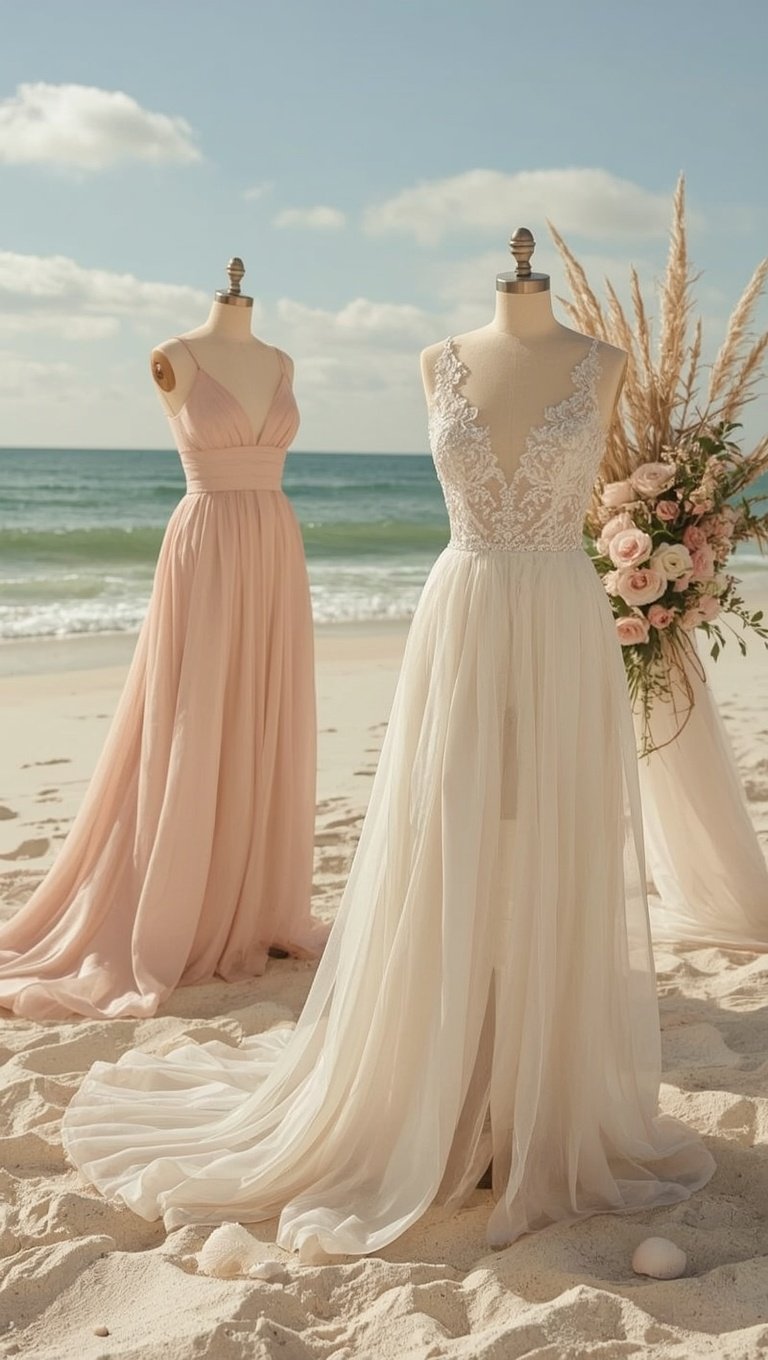
I’m a little obsessed with a-line and slip silhouettes for beach ceremonies.
They skim the body instead of clinging or ballooning out.
A structured ballgown can look stunning on a church aisle.
But on sand, with wind involved, it can start to feel like a battle.
I’ve watched brides basically wrestle their skirts the entire ceremony.
That’s not the memory you want.
A softly gathered a-line gives you shape without stiffness.
A bias-cut slip dress feels effortless, almost like a second skin.
If you want a little drama, look for a silhouette with a fitted bodice and a flowing, unlined skirt.
You get definition up top and movement down below.
That combination photographs beautifully in wind, by the way.
The fabric lifts just slightly, like the dress is breathing with the ocean.
If I were choosing for myself again, I’d lean toward a subtle empire waist too.
It’s forgiving, it’s romantic, and it never feels heavy against your skin.
Comfort and movement, that’s the whole goal here.
Necklines That Play Nice With Ocean Wind

Here’s a detail nobody warns you about.
Some necklines just do not survive wind.
Strapless can be gorgeous, but it also asks a lot of you all day.
You’re constantly adjusting, tugging, hoping it stays put.
I’d rather see you in something secure and still soft.
A halter neckline is one of my favorite options for beach settings.
It keeps everything anchored while still feeling open and romantic.
An off-the-shoulder style with structured elastic can work beautifully too.
It gives you that dreamy, flowy look without the constant worry.
Square necklines are underrated, honestly.
They feel modern, they stay put, and they photograph so well against blue water.
If you love the strapless look, just ask your seamstress about adding boning or a light corset lining.
That little structural support makes a huge difference in wind.
You still get the look you dreamed of.
You just get to actually enjoy your day instead of fixing your dress every five minutes.
Hemlines: My Honest Take on Hi-Lo, Tea-Length, and Barefoot-Friendly Cuts

Sand and long hems have a complicated relationship.
I love a dramatic full-length gown as much as anyone.
But I’ve also seen a train collect an entire beach’s worth of sand by the reception.
If you want that classic long silhouette, look for a detachable train.
You get your ceremony photos, then you get your freedom.
Tea-length dresses are having such a moment for beach weddings, and I completely understand why.
They hit right at the shin, they show off a little ankle, and they feel playful.
If I had a beach wedding tomorrow, this is probably where I’d land.
Hi-lo hems are another gorgeous option, short in front and longer in back.
They give you drama for the photos and ease for the dancing.
And if you’re going fully barefoot, keep the hem just above ankle length.
Anything longer tends to drag and gather sand fast.
Trust me on this one, your dress will thank you by the end of the night.
Fabrics I’d Gently Steer You Away From

I don’t love being the bearer of bad news, but someone has to say it.
Heavy taffeta is stunning in a ballroom and rough on a beach.
It’s stiff, it rustles loudly in wind, and it doesn’t breathe well in heat.
Thick satin can feel similarly heavy, especially in humid coastal climates.
Structured tulle skirts are romantic, but they can act like a sail in strong wind.
I’ve genuinely seen a tulle skirt flip sideways mid-ceremony.
Everyone laughed, but the bride was mortified in the moment.
Sequined or heavily beaded fabrics are another one to reconsider.
They’re gorgeous under string lights, but they trap heat and add real weight.
On a hot beach afternoon, that extra weight gets exhausting fast.
If you love a little sparkle, save it for delicate embroidery instead of dense beading.
A light hand-sewn detail catches the sun just as beautifully.
And it won’t leave you overheated by the vows.
Color Beyond Stark White

Can we talk about color for a second, because I think this gets overlooked.
Stark white is beautiful, but it can look almost harsh against golden sand and blue water.
I’m so drawn to warmer shades for beach settings.
Ivory feels soft and a little vintage.
Champagne has this gorgeous warmth that photographs beautifully at golden hour.
Blush is romantic without feeling overly sweet.
Even a pale seashell pink can feel bridal while adding warmth to your skin tone.
When my friend wore a champagne silk gown for her Greece wedding, it genuinely looked like it was glowing in the sunset photos.
White would have looked flat in comparison, in my honest opinion.
If tradition matters to you, that’s completely valid too.
Just know that warmer whites, like a soft ivory or oyster, tend to feel less stark against a beach backdrop than a bright, cool white.
It’s a small shift that makes a big visual difference.
Accessorizing Without Weighing Yourself Down

Less is genuinely more here, and I say that as someone who loves accessories.
Heavy statement jewelry can feel like a lot against a light, flowy dress.
I’d rather see you in delicate gold pieces that catch the light softly.
A thin layered necklace, small drop earrings, maybe a simple bracelet.
That’s it, that’s the whole formula.
Your dress and the ocean are already doing the heavy lifting visually.
For your hair, a few fresh flowers tucked in feel so much more beach-appropriate than a heavy tiara.
I’m also a big believer in a delicate anklet if you’re going barefoot.
It’s such a small detail, but it photographs beautifully in sand shots.
If you want a belt or sash, choose something thin and soft, not stiff or bulky.
A delicate ribbon sash in a matching tone adds definition without adding weight.
Remember, every single piece you add should feel like it’s floating, not anchoring you down.
Hair and Veil Strategy for Windy Ceremonies

I have strong feelings about veils in wind, so let’s get into it.
A long cathedral veil is breathtaking in photos, truly.
It’s also nearly impossible to control in a coastal breeze.
If you love the veil look, consider a shorter blusher or fingertip length instead.
It gives you that romantic movement without the wrestling match.
For hair, I always recommend something secured, like a low braid or a soft twisted updo.
Loose curls are gorgeous, but they can turn into a tangled mess within the hour.
A few face-framing pieces left out still give you that soft, romantic feel.
Texturizing spray is your best friend here, it holds up so much better than a heavy hairspray in humidity.
If you’re using flowers in your hair, ask your stylist to secure them extra well with pins.
Trust me, chasing a flower across the sand is not how you want to spend your ceremony.
Small adjustments, big peace of mind.
Shoes, Sandals, or Bare Feet, My Real Opinion

I’ll be honest, I think bare feet is the most beautiful option for an actual beach ceremony.
There’s something so intimate about standing in the sand with nothing between you and the earth.
But I know not everyone loves that idea, and that’s completely fine too.
If you want something on your feet, look for flat, delicate sandals.
Anything with a heel is genuinely fighting a losing battle against sand.
I’ve watched a bride sink an inch with every step in her heels once, and it was stressful to watch, let alone experience.
A soft leather sandal or even a barefoot sandal with delicate straps looks beautiful in photos.
My favorite trick is packing a pair of comfortable flats for the reception, even if you go barefoot for vows.
Your feet will thank you after a full day of celebrating.
And honestly, nobody is looking at your shoes when the ocean is right behind you.
Layering Pieces for When the Breeze Turns Cool

Beach weddings are warm during the day and surprisingly cool once the sun goes down.
I always tell brides to plan for that temperature shift.
A delicate silk robe or wrap for getting ready photos feels so dreamy, by the way.
For the evening, a soft cardigan or a light shawl in a matching tone works beautifully.
I personally love a delicate lace bolero, it adds coverage without hiding your dress.
A faux fur stole feels a little unexpected for a beach wedding, but it can look stunning against an evening sky.
If your dress has thin straps or is strapless, packing a cover-up isn’t just practical, it’s smart styling too.
You get gorgeous uncovered shoulders for your ceremony photos.
Then you stay comfortable and warm once the temperature drops for dancing.
I promise your future self will be so grateful you packed something warm.
Cute and cozy can absolutely coexist, and honestly, that’s kind of my whole brand.
Sustainable and Breathable Fabric Options I Love

If eco-conscious choices matter to you, beach weddings actually pair beautifully with sustainable fabrics.
Organic cotton voile is soft, breathable, and gentle on skin in heat.
Linen blends have this gorgeous relaxed texture that feels effortlessly bridal.
Tencel is another one I’m a little obsessed with lately.
It’s made from sustainably sourced wood pulp, and it drapes like a dream.
Recycled lace is becoming more available too, and it adds romance without the environmental cost of new production.
When I researched options for my own future wedding, I was surprised how many small designers now specialize in these fabrics specifically for destination and beach ceremonies.
They tend to breathe better in humidity than synthetic blends anyway.
So it’s a win for your comfort and a win for the planet.
If sustainability is important to you, ask your designer directly about fabric sourcing.
Most are proud to talk about it, and honestly, it’s such a meaningful detail to build into your dress story.
Packing and Travel Tips for a Destination Beach Wedding

Traveling with a wedding dress is its own kind of stressful, I won’t sugarcoat it.
Always carry your dress on the plane, never check it.
I know it feels like a lot to manage, but trust me here.
Ask your hotel about steaming services the moment you arrive, humidity actually helps release travel wrinkles.
A fabric steamer is gentler than an iron for delicate fabrics like chiffon or silk.
Pack a small emergency kit too, safety pins, fashion tape, a small sewing kit, and stain remover wipes.
Sand has a sneaky way of finding its way into everything, so a small handheld brush is genuinely a lifesaver.
If your dress has a train, ask someone in your party to be your designated train-holder during any sandy walking.
I also always recommend doing a trial walk on actual sand before the big day if you can.
It tells you so much about how the hem behaves and whether you need any last adjustments.
A little preparation goes such a long way toward a stress-free morning.
Alteration Tips Specific to Beach Conditions

Beach weddings really do call for slightly different alterations than a traditional venue.
I always tell brides to bring sand-like texture or even go to a real beach for their final fitting if possible.
Standing on an uneven, soft surface changes how a hem falls completely.
Ask your seamstress about a slightly shorter hem than you’d choose for a ballroom.
Even half an inch makes a difference when you’re walking on sand.
Consider asking for a light horsehair braid finish along the hem, it helps the fabric hold its shape without adding stiffness.
If you’re barefoot, request they double check the hem length while you’re actually standing without shoes.
Heels change your height more than people realize.
For humid climates, ask about breathable lining fabrics instead of heavier traditional linings.
Your comfort in the heat matters just as much as how the dress photographs.
And honestly, a good seamstress who understands beach conditions specifically is worth every penny.
It’s such a small investment for a dress that will actually move beautifully with you all day.