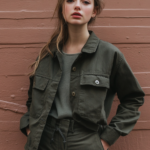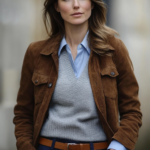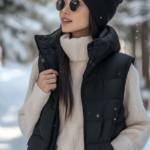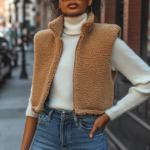

There are two kinds of cold-weather outfits: the ones that keep you warm and make you look like a marshmallow, and the ones that look great for the walk from the car and leave you shivering at the bus stop.
Layering is how you get both.
The trick (and it really is just one trick) is that the layers don’t all do the same job.
Once you know each one’s job, they stop piling up on your frame.
Outdoor gear experts have already worked out the system, and it holds up on a city sidewalk.
A thin layer next to the skin, a warm layer over it, a coat on top.
What changes for everyday clothes is how you pick each piece so the outline stays slim.
I’d lay the whole outfit out the night before, because the layers go on in order and you can see the shape before you’re running late.
Start With a Base Layer That Fits Close
The layer against your skin has one job: to pull moisture away from the skin and spread it through the fabric.
It should also fit snugly, which is what keeps it thin under everything else.
A loose one bunches under a sweater.
Nope.
Skip cotton for this layer if you’re going to be moving.
Seriously.
A cotton base does wick moisture, but it holds onto it, loses its warmth and cools you down as it dries.
Merino wool is the usual swap.
It’s thin and lightweight, and less itchy than traditional wool, and it keeps insulating even when it gets damp.
A synthetic base layer dries faster and costs less, but it tends to hold on to odor.
So it’s a call between your budget and your nose.
I’d spend on merino for the pieces you wear most.
Two merino tops cover a week if you rotate them.
For everyday outfits, the base layer is usually a long-sleeve tee, a fitted turtleneck or a thin knit.
Match the neckline to what goes over it: a crew neck under a crew neck, a mock neck under a V. A neckline that peeks out on purpose looks planned.
One that peeks out by accident looks like a mistake.
Our turtleneck outfits post has easy ways to wear one on its own or under something.
The Middle Layer Is Where the Warmth Comes From

Warmth comes from trapped air, which is why the middle layer has some loft to it.
A mid-layer captures warmth through trapped air and also has to stay breathable, so it isn’t suffocating and sweat-causing under a coat.
In street clothes that’s a cardigan, a fleece pullover, a wool sweater or a knit vest.
Bulk creeps in here.
Chunky knit over chunky knit adds inches at the middle and arms (and it isn’t any warmer than a medium knit that fits well).
Pick one medium-weight piece that sits close enough to hold its shape but not so tight that it squeezes the base layer.
A cardigan that ends about 2 inches below the base layer’s hem is a good place to start, since staggered hems read as deliberate and keep a long-sleeve tee from showing at the bottom.
Want a middle layer that shows?
This is the one.
A knit sweater outfit can carry the color, and the base layer underneath stays quiet in white, black or a shade close to your skin tone.
Keeping the colors in the same family also cuts the visual bulk.
The eye reads one shape, not three.
Your Coat Needs Room for Everything Under It

The coat is the layer people get wrong most often, because they try it on in a store wearing a tee.
An insulating jacket should be sized to fit comfortably over a light fleece and under an outer shell, and a coat for street clothes follows the same logic: it has to close over the sweater without pulling across the shoulders.
If it only fits over a tee, it isn’t a winter coat for you yet.
Honestly, that’s the most common mistake I see in a fitting room.
Bring your thickest sweater when you shop, or wear it.
Raise your arms.
Reach forward.
Sit down.
If the sleeves ride up or the back pulls tight, go up a size (even 1 size is enough) or look at a different cut.
Try at least 3 coats before you decide.
Several layers of loose clothing insulate better than one tight layer, and a coat that’s tight across the shoulders works against that.
A longer coat tends to read slimmer over layers, since the line runs unbroken.
That’s my pick for anyone who layers a lot.
Our guide to winter coats that look sharp over everything underneath goes through the cuts that handle a bulky sweater without turning boxy.
Short version: longer, straighter, a little roomy.
Wind Beats Most Outfits Before Temperature Does

A cold, still day and a cold, windy day can feel like two different climates.
Weirdly, the second one is the one people dress for less.
Wind changes how cold you feel more than the number on the thermometer.
Protection from wind chill makes a significant difference in how warm you feel, and a light wind jacket gives a lot of warmth for little weight, so a thin windproof layer is worth more than a second sweater.
For city clothes, that means the outer layer matters more than you’d think.
If your coat is the thin, stylish kind, a thin windproof layer under it is the quiet fix, and it adds almost nothing to the silhouette (genuinely, almost nothing).
When temperatures drop, heat can rapidly leave your body.
The pieces you leave off matter as much as the ones you add.
Don’t Forget Your Neck, and Don’t Forget Your Feet

A big share of feeling cold is down to the parts that aren’t covered.
Yeah, it’s the ears and the ankles.
Cover the ears and face first, then the hands and feet, and wear a hat, since hats reduce body heat escaping from your head.
For feet, boots should be waterproof and insulated, and it’s worth carrying an extra pair of socks if you’ll be out all day.
Legs get layers too.
Tights under jeans or trousers are the easiest way to add warmth without any bulk at the waist, and a skirt or dress with warm tights and boots is a better winter outfit than most people give it credit for.
Worth a try.
Wool or thick tights work for dresses, and the long coat covers the rest.
For a night out in heels, wear the boots for the walk and swap at the door.
Pack the heels in a tote.
A 15-minute walk in heels on ice is nobody’s idea of a night out.
A scarf is the layer you can take off.
It handles the neck, sits under the coat’s collar and doesn’t add bulk to the torso.
Ways to wear a scarf has more ideas for tying one.
Three Layered Looks That Keep the Shape

Look one is the work-day outfit: a fitted turtleneck, a long open cardigan and straight trousers, with a long coat on top.
Everything runs vertical, the cardigan’s edge draws a line down the front, and the only bulk sits where you want warmth, at the middle.
Add flat boots and it handles a walk, a train and an office with a thermostat nobody controls (every office has one).
Look two is for a dress, and it’s my favorite.
Put a thin long-sleeve tee under a sleeveless dress or a slip, add opaque tights and boots, then a coat that ends below the hem.
It looks like one outfit, not a dress with something stuffed under it.
The tee echoes the tights in color.
One color family, 2 shades apart at most.
Black on black or navy on navy is the easiest way to keep it from looking busy.
Done.
Look three is the weekend outfit: a thermal base, a medium-weight sweater and jeans, with a puffer or parka on top.
Bulk is hardest to control here, so keep the sweater fitted and let the coat carry the volume.
A scarf in the same tone as the coat lengthens the line, and a beanie finishes the outfit without adding more layers.

Each of these has a base that fits, a middle that traps warmth without adding inches, and a coat sized for both.
Swap in your own pieces and the proportions carry over, and none of it needs a bigger closet.
If you’re short on room, 3 good middle layers in different weights cover more days than a rack of coats, and a thrift-store wool coat with the right shoulders beats a new one that pulls.
I’d hunt for 1 good coat before buying a second sweater.
Take a Layer Off Before You Start to Sweat
A layered outfit that’s too warm is as bad as one that’s too cold.
Overheating can be as big a problem as keeping warm when you’re active in the cold, and a damp base layer is what turns a cozy commute into a chilly one an hour later.
The whole point of layers is that you can take one off.
Sort of obvious, but easy to forget at 8 a.m.
So plan the order.
The first piece to come off should be the easiest to remove: a scarf, then the coat, then the cardigan.
A zip-neck base layer gives you another way to cool down without stopping to undress.
Unzip 3 inches and you’re fine.
Indoors, the coat comes off first, and the cardigan is what you keep on, so make sure that’s the one that looks good alone.
Give yourself 2 minutes in the bathroom mirror (not a 30-second glance), with the coat off and then on.
The outfit has to work both ways.
You’ll be in the middle layer more often than you expect, and it’s the one people see at lunch.
If it looks right in both, the layers are doing their job.
For more outfits that start from this logic, our cozy winter outfits are a good place to keep going.
Sources: OutdoorGearLab, how to layer clothing to keep warm; CDC NIOSH, cold stress.